Good fats, bad fats: swap the solid ones for fats that pour
On this page
- The map
- Why does butter sit solid and olive oil pour?
- One test sorts almost every fat
- What do the solid fats do to your heart?
- How much solid fat fits in a day?
- Your day usually has one big source
- Pouring fats still need a meal around them
- Which oil for which job?
- Fish twice a week, before any capsule
- What about seed oils?
- What changed in 2026?
- When the advice changes
- Why are you here?
- What the evidence shows, and where it stops
- The simple plan
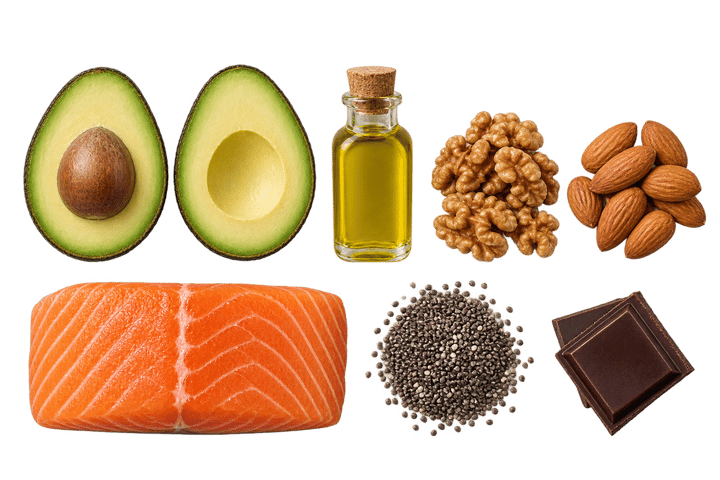
Fat isn’t bad for you, and it isn’t all one thing. The fats that sit solid on your counter, like butter, coconut oil, tallow and the fat in cheese and fatty meat, push your LDL cholesterol up. The ones that pour, like olive and canola oil and the fat in nuts, avocado and fish, bring it down when they take the solid ones’ place. Swap the first kind for the second, and eat fish twice a week. You can do all of it with food, if you want to and if you can, before any capsule or pill.
You’d think that’s what everyone would be talking about. Instead the loudest fight online is about seed oils, and in January 2026 the new US guidelines listed butter and beef tallow as fats you can cook with. Meanwhile more than 70% of US adults eat more saturated fat than the guidelines’ line, and most of it comes from fatty meat, full-fat dairy and butter, often inside sandwiches, burgers and desserts.
What we’d do
Cook with extra virgin olive oil, and keep canola for baking and the hottest jobs. Find the biggest solid fat in your own day, usually butter, cheese or fatty meat, and swap that one first. A tablespoon of butter is a third of a 2,000 calorie day’s saturated fat line.
Eat salmon, sardines or trout twice a week before you buy a fish oil capsule. Then test your cholesterol 6 to 12 weeks after the swap, at the same lab, to see what it did for you.
If you remember three things
- Solid fats out, pouring fats in. Butter, coconut oil and tallow sit solid because they’re mostly saturated fat. Olive and canola oil pour because they’re mostly not.
- Your line is 10% of your calories. That’s about 22 g on 2,000 calories, and one tablespoon of butter is 7.2 g of it.
- Eat the fish before you buy the capsule. In a trial of 25,871 people, fish oil capsules didn’t prevent major heart events.
The map
- The four fats, and why some are solid. Straight chains, kinked chains and the fats your body can’t make.
- How much fat, and how much saturated fat? Your line in grams, and why the label says 20 g.
- What saturated fat does. The liver’s drain, and what cutting it did in 15 trials.
- Where the saturated fat in your day comes from. Usually one or two foods.
- Oils in the kitchen. Which oil for which job, and what smoke point leaves out.
- Omega-3 and omega-6. The fish week, the capsule trials and the ratio.
- Trans fat: mostly gone, not all. The oil that was made solid on purpose.
- When the advice changes. Keto, vegan, pregnancy, children and GLP-1 medicines.
- How to check your swap worked. One change, then one retest at the same lab.
- What changed about fat in 2026. New guidelines, a school milk law and a retracted keto study, with their dates.
- Are seed oils bad for you? The loudest fight, claim by claim.
Why does butter sit solid and olive oil pour?
Put a stick of butter and a bottle of olive oil side by side on a warm counter. One holds its shape and the other runs, and both are mostly fat.
The difference is the shape of the chains. Every fat is built from chains of carbon atoms. In saturated fat the chains are straight, so they stack against each other like pencils in a box and hold together. In olive oil most chains have a kink in the middle, so they can’t line up, and they slide around like bent paper clips in a jar.
One kink changes a lot. Stearic acid, a straight saturated chain of 18 carbons, melts at about 157 °F (69 °C). Oleic acid has the same 18 carbons with one kink, and it melts at about 56 to 61 °F (13 to 16 °C), so it stays liquid at room temperature. In the extra virgin olive oil from one lab test, three quarters of the fat was oleic acid.
 Saturated
 Monounsaturated
 Polyunsaturated
 Trans
The same shapes change what each fat does inside you. Saturated fat slows how fast LDL is cleared from your blood, and unsaturated fats add more LDL receptors to your liver, the drain that pulls LDL out. Swap one for the other and LDL goes down, and cholesterol.guide works out by how much for your own number. The four fats has the chemistry, and the essential fats your body can’t make.
One test sorts almost every fat
You can sort most cooking fats with your eyes. If it sits solid in a cool kitchen, it’s mostly saturated, and it’s the kind to cut back. If it pours, it’s mostly unsaturated, and it’s the kind to cook with.
Sits solid in a cool kitchen
Pours
- Saturated
- Monounsaturated
- Polyunsaturated
Coconut oil is the one that surprises people. It comes from a plant and gets sold as a health food, but a tablespoon holds 11.2 g of saturated fat, more than butter’s 7.2. That’s about 83% of its fat, against butter’s 62%. In 16 trials it raised LDL compared with plant oils like olive and canola, and cholesterol.guide has the size of it.
Trans fat fits the test too. Food makers used to turn liquid oil into solid shortening and stick margarine by partly hydrogenating it, which straightened some of the kinks and made trans fat. In 2015 the FDA ruled that those oils were no longer recognized as safe, makers couldn’t add them to food after June 18, 2018, and the last products had to be gone by January 1, 2021. A little trans fat still occurs naturally in milk, butter and meat. Trans fat covers what’s left.
The test sorts fats, not foods. Fries cooked in a pouring oil are still fries, and every fat has 9 calories a gram, solid or not. The oil compare puts any two of 13 cooking fats side by side.
What do the solid fats do to your heart?
They raise LDL, and the trials that cut them found fewer heart problems. The Cochrane review pooled 15 trials that lasted at least two years, with 56,675 people. Eating less saturated fat cut heart attacks, strokes and other heart events by 17%. Among people without heart disease, 56 had to cut it for about four years for one of them to avoid an event. The same review found little or no change in deaths, which is why both sides of the argument quote it.
What you eat instead decides how much good the cut does, and plant oils have the most evidence behind them. In 221,054 US adults followed for up to 33 years, swapping 10 g of butter a day for plant oils went with 17% fewer deaths. That’s an observational study, so the people who ate more plant oil may have been different in other ways too. What saturated fat does has the trials, and cholesterol.guide ranks every change by how much it moves LDL.
How much solid fat fits in a day?
The US line is under 10% of your calories from saturated fat. On 2,000 calories that’s about 22 g, on 1,500 about 17 g and on 2,500 about 28 g. The 20 g on a food label is a different number. It’s a fixed Daily Value, the same for everyone, so on 1,500 calories it’s more than your line and on 2,500 it’s less.
One portion, against a 22 g line
-
 A tablespoon of coconut oil 11.2 g 50%
-
 A tablespoon of butter 7.2 g 32%
-
 3 oz of 73% lean ground beef 6.9 g 31%
-
 A butter croissant 6.6 g 30%
-
 An ounce of cheddar 6.0 g 27%
-
 A cup of whole milk 5.1 g 23%
-
 A tablespoon of olive oil 1.8 g 8%
One tablespoon of butter uses a third of a 2,000 calorie line, and a tablespoon of coconut oil uses half. How much saturated fat a day? works out your line in grams, and is 20 g of saturated fat too much? explains the label.
Your day usually has one big source
Across the US, the most saturated fat comes from sandwiches and burgers, then desserts and sweet snacks, then rice, pasta and other mixed dishes. In one person’s day it’s usually one or two foods, and those are the ones to change.
One ordinary day
- Two eggs3.2 g
- A tablespoon of butter to cook them7.2 g
- An ounce of cheddar6.0 g
- A 3 oz burger, 83% lean5.5 g
- A cup of whole milk5.1 g
27.0 g of saturated fat, over a 22 g line
21.6 g after one swap: olive or canola oil in place of the butter
Change the biggest source first and leave the rest alone. The fat scorer does this for any day you put in, and where it comes from has the foods that carry the most. If cooking fat is your big one, the easiest way to cut saturated fat is one bottle.
Pouring fats still need a meal around them
meals.guide judges a meal on six jobs, and it calls olive oil, avocado and almonds great at one of them and short on the rest. We agree. The pouring fats are the best way to add fat to a plate, and they bring almost no protein or fiber. A spoon of olive oil finishes a meal of beans, fish or vegetables, and on its own it isn’t a meal however good the oil is. The meal checker grades a whole plate, and A+ meals shows plates that get the fat right.
How much fat in total has a wide healthy range, 20 to 35% of calories for adults, which is about 44 to 78 g on 2,000 calories. In the DIETFITS trial, 609 adults ate a healthy low-fat or a healthy low-carb diet for a year and lost about the same weight, about 12 and 13 pounds (5.3 and 6.0 kg). The kind of fat counts for more than the amount. Eating fat makes you fat has that trial, and how much fat a day? gives your range.
Which oil for which job?
Two oils cover a kitchen. Use extra virgin olive oil for most cooking, frying included, and a neutral oil like canola for baking and dishes where you don’t want the olive taste.
Smoke point is the number people pick oils by, and in the one lab test that checked, it didn’t predict how an oil held up. In that test of ten supermarket oils, extra virgin olive oil smoked at 404 °F and canola at 492 °F. Then the lab heated each oil twice, for 6 hours in a deep fryer at 356 °F and once in a pan up to 464 °F, and measured the breakdown products. Averaged over the two tests, extra virgin olive oil made the fewest and canola the most.
Breakdown after heating, averaged over both tests
Extra virgin was lowest on the average of the two tests, not in each one, and coconut oil was close behind. The lab belongs to an olive oil company, and no food was cooked, which changes the chemistry. Coconut oil holds up in the pan because saturated chains have no kinks to break, and its cost shows up later, in your LDL. Oils in the kitchen has the full test, and in it the avocado oil smoked before the olive oil.
Fish twice a week, before any capsule
The US advice on omega-3 is to eat seafood, at least 8 ounces a week. The fish you pick changes how much omega-3 you get by ten times or more.
8 ounces a week of one fish gives you, a day
-
 Salmon, farmedBest Choice 700 mg
- HerringBest Choice 650 mg
-
 Mackerel, AtlanticBest Choice 390 mg
-
 SardinesBest Choice 320 mg
- TroutBest Choice 280 mg
-
 Tuna, albacore 280 mg
- Tuna, canned lightBest Choice 72 mg
-
 CodBest Choice 51 mg
-
 ShrimpBest Choice 10 mg
Capsules did less in trials than people hoped. In VITAL, 25,871 US adults took 1 g of fish oil or a placebo every day for a median of 5.3 years.
Major heart events in five years, VITAL
Across seven big trials with 81,210 people, fish oil also raised the risk of atrial fibrillation, an irregular heartbeat, by about 25%, and by about half in the trials that gave more than 1 g a day. Above 1 g a day of EPA and DHA, talk to your doctor first. What foods are high in omega-3? lists the fish and plants, omega-3 and omega-6 has the rest, the omega-3 counter adds up your week, and the fish oil label check shows what a capsule really holds.
What about seed oils?
Seed oils are canola, soybean, corn, sunflower and the other oils pressed from seeds, and they’re the loudest fight in fat right now. The main claim is that they cause inflammation. In 15 randomized trials in healthy people, eating more linoleic acid, the main fat in most seed oils, didn’t raise CRP or the other inflammation markers the researchers measured. In the 221,054-person study, people who ate the most plant oil had 16% fewer deaths than those who ate the least.
The heat claim has something in it. In the lab test above, the oils highest in polyunsaturated fat broke down the most, so fry with olive oil and don’t fry in the same oil night after night. And seed oils often arrive inside fried and packaged food, which is the better thing to eat less of. Are seed oils bad for you? goes claim by claim, and processing.guide covers the claim that they’re ultra-processed.
What changed in 2026?
The January 2026 Dietary Guidelines put olive oil first, listed butter and beef tallow as other options, said to include full-fat dairy with no added sugars, and kept saturated fat under 10% of calories. They also said “more high-quality research is needed to determine which types of dietary fats best support long-term health”. On January 14, 2026, a new law let schools serve whole milk again. In May 2026 a journal retracted the keto study that said ApoB didn’t predict new plaque. What changed about fat in 2026 has each one with its date, and is butter back? works through the butter line.
When the advice changes
- On keto or very low carb: keep the carbs low and change the fat, from butter, cream and fatty meat to olive oil, avocado, nuts and fish. Why is my LDL high on keto?
- Vegan: plant omega-3 is easy from flax, chia and walnuts, and algae oil has EPA and DHA directly. How vegans get omega-3
- Pregnant or breastfeeding: 8 to 12 ounces of fish a week from the FDA’s lowest-mercury list. How much fish while pregnant
- Children: the 2026 guidelines call full-fat dairy “important for children”, and pediatricians still advise lower-fat milk from age 2. Should kids drink whole milk?
- On a GLP-1: smaller meals with less fat usually sit better. Fatty foods on Ozempic
- LDL high on a good diet: genes can set LDL high whatever you eat. When the advice changes and cholesterol.guide take it from there.
Why are you here?
-
 I'm trying to lose weightFat has 9 calories a gram, and low fat and low carb lost the same in a year
-
 Which oil should I cook with?One oil for most cooking, one for the hottest jobs
-
 I keep hearing seed oils are toxicEach claim against what the trials found
-
 I heard butter is healthy nowWhat the 2026 guidelines changed, and what they kept
-
 Should I take fish oil?A 25,871-person trial, and the fish that does the job
-
 My cholesterol came back highThe fat swap, and where the rest of the plan lives
-
 I'm reading food labelsWhy the 20 g on the label may not be your number
-
 I eat keto or low carbKeep the carbs low and change the fat
-
 I'm vegan or vegetarianPlant omega-3, and the one source of EPA and DHA
-
 I'm on a GLP-1Why greasy food sits badly, and what sits better
-
 I'm pregnant or breastfeedingHow much fish, and which ones
-
 I'm feeding kidsWhole milk is back in schools. What that means
-
 Heart disease runs in my familyWhat saturated fat does, and what cutting it did in trials
What the evidence shows, and where it stops
We’re confident that swapping saturated fat for plant oils lowers LDL, and that eating less saturated fat cut heart events in trials. The evidence that it saves lives is thinner, since the Cochrane review found little or no change in deaths. The evidence that seed oils are harmful is weak, and the evidence that fish oil capsules protect healthy people’s hearts is weak too.
Nobody knows yet exactly which unsaturated fat is best, and the newest US guidelines say so. People also respond differently to the same swap, so your own cholesterol test is the one that shows what it did for you.
The simple plan
- Start with your cooking fat. If it’s butter, coconut oil or tallow, use extra virgin olive oil for most cooking and canola for baking. Food comes first here, before any capsule or pill, if you want to and if you can, and for most people this one bottle is the biggest change.
- Find your biggest solid fat. Put a usual day into the fat scorer and change the top source, whether that’s cheese, fatty meat, pastry or the butter on your toast. Leave the rest.
- Know your line. Under 10% of your calories, about 22 g on 2,000. Your line in grams.
- Eat fish twice a week. Salmon, sardines, trout or herring, about 4 ounces each time, and walnuts, chia or ground flax if you like them. What foods are high in omega-3? has the list. Think about a capsule only after that, and read its back label.
- Track it. Photograph your meals in Gyroscope. With Gyroscope One, every meal photo shows its saturated, monounsaturated, polyunsaturated and trans fat next to the calories, with a trend for each once your log is consistent.
- Check it worked. 6 to 12 weeks after the swap, test your LDL and ApoB with the Gyroscope home blood test (half price with Gyroscope One), or photograph the report from any lab, and every result is graded and trended, so you can see whether the swap moved them. How to check your swap worked.
20 sources
- US Department of Agriculture and US Department of Health and Human Services, Dietary Guidelines for Americans, 2025 to 2030, pp. 2 to 3, 7 and 8, January 2026cdn.realfood.gov
- US Department of Agriculture and US Department of Health and Human Services, Dietary Guidelines for Americans, 2020 to 2025, pp. 44, 100 and 133, December 2020dietaryguidelines.gov
- US Food and Drug Administration, Daily Value on the Nutrition and Supplement Facts Labelsfda.gov
- Gebhardt and Thomas, Nutritive Value of Foods, Home and Garden Bulletin 72, Table 9, USDA Agricultural Research Service, 2002ars.usda.gov
- USDA FoodData Central SR Legacy, Oil, coconut (FDC 171412), as listed on NutritionValue.orgnutritionvalue.org
- PubChem, Stearic acid (CID 5281), melting point from the CRC Handbook of Chemistry and Physicspubchem.ncbi.nlm.nih.gov
- PubChem, Oleic acid (CID 445639), melting pointpubchem.ncbi.nlm.nih.gov
- Fernandez and West, Mechanisms by which dietary fatty acids modulate plasma lipids, Journal of Nutrition, 2005pubmed.ncbi.nlm.nih.gov
- Neelakantan, Seah and van Dam, The effect of coconut oil consumption on cardiovascular risk factors, Circulation, 2020pubmed.ncbi.nlm.nih.gov
- US Food and Drug Administration, Trans Fatfda.gov
- Hooper and others, Reduction in saturated fat intake for cardiovascular disease, Cochrane Database of Systematic Reviews, 2020pmc.ncbi.nlm.nih.gov
- Zhang and others, Butter and plant-based oils intake and mortality, JAMA Internal Medicine, 2025pmc.ncbi.nlm.nih.gov
- Gardner and others, Effect of low-fat vs low-carbohydrate diet on 12-month weight loss in overweight adults (DIETFITS), JAMA, 2018pmc.ncbi.nlm.nih.gov
- De Alzaa, Guillaume and Ravetti, Evaluation of chemical and physical changes in different commercial oils during heating, Acta Scientific Nutritional Health, 2018, Tables 1, 2 and 5 (Modern Olives Laboratory Services)actascientific.com
- US Food and Drug Administration, Advice about Eating Fish, content current as of March 5, 2024fda.gov
- Manson and others, Marine n-3 fatty acids and prevention of cardiovascular disease and cancer (VITAL), New England Journal of Medicine, 2019pmc.ncbi.nlm.nih.gov
- Gencer and others, Effect of long-term marine omega-3 fatty acids supplementation on the risk of atrial fibrillation in randomized controlled trials of cardiovascular outcomes, Circulation, 2021pmc.ncbi.nlm.nih.gov
- Johnson and Fritsche, Effect of dietary linoleic acid on markers of inflammation in healthy persons: a systematic review of randomized controlled trials, Journal of the Academy of Nutrition and Dietetics, 2012pubmed.ncbi.nlm.nih.gov
- Retraction notice: Longitudinal data from the KETO-CTA study: plaque predicts plaque, ApoB does not, JACC: Advances, May 2026europepmc.org
- DTN Progressive Farmer, President Trump signs Whole Milk for Healthy Kids Act, January 16, 2026dtnpf.com