Which oil should I cook with?
Pick two. A tablespoon of each, side by side, with the smoke point only where a bottle was actually tested.
- Saturated
- Monounsaturated
- Polyunsaturated
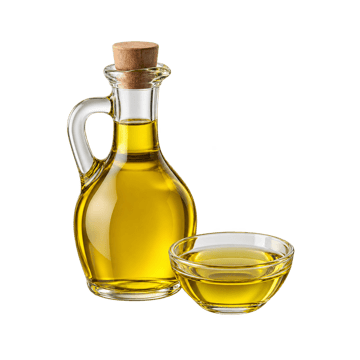
Coconut oil
11.2 g saturated a tablespoon
- Mono
- 0.9 g
- Poly
- 0.2 g
- Saturated share
- 83%
Smoked at 376 °F (191 °C) in one 2018 lab test of supermarket bottles.
The most saturated cooking fat, about 83%. Use it for flavor, not as your everyday oil.
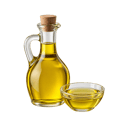
Olive oil
1.8 g saturated a tablespoon
- Mono
- 9.9 g
- Poly
- 1.1 g
- Saturated share
- 13%
Smoked at 404 °F (207 °C) in one 2018 lab test of supermarket bottles (extra virgin 404 °F, olive 406 °F, virgin 348 °F).
Everyday cooking, roasting and dressing. In the test, extra virgin olive oil made the fewest breakdown compounds averaged over both heating runs, with coconut oil close behind.
The heat test
Deep frying usually tops out at 356 °F (180 °C). Averaged over both heating runs, extra virgin olive oil made the fewest breakdown compounds of the ten bottles, with coconut oil close behind, and canola the most. Smoke point didn't predict that. The lab was an olive oil company's (de Alzaa 2018), and the test bottles were Australian.
These are the US guideline's lines. The Gyroscope app personalizes yours.
What your result means
- Picking an everyday oil: take the one with less saturated fat. Every oil that pours has at least 4 g less a tablespoon than butter, ghee, tallow or coconut oil.
- Cooking hot: averaged over two heat tests, extra virgin olive oil broke down the least of ten oils and canola the most. The smoke point shown is the one bottle tested.
- No smoke point shown: that fat wasn't in the test, and this tool doesn't borrow a number from a label.
- Using butter or coconut oil for flavor: count it. A tablespoon of coconut oil is half a 2,000 calorie day's line, and butter a third.
Olive oil or canola oil? and oils in the kitchen go further.
One tablespoon, thirteen fats
Grams per tablespoon, most saturated first, against a 2,000 calorie day's line of 22 g.
| Fat | Saturated | Mono | Poly | Share of 22 g | Smoke point measured |
|---|---|---|---|---|---|
| Coconut oil | 11.2 g | 0.9 g | 0.2 g | 50% | 376 °F |
| Ghee | 7.9 g | 3.7 g | 0.5 g | 36% | not tested |
| Butter | 7.2 g | 3.3 g | 0.4 g | 32% | not tested |
| Beef tallow | 6.4 g | 5.4 g | 0.5 g | 29% | not tested |
| Lard | 5.0 g | 5.8 g | 1.4 g | 23% | not tested |
| Peanut oil | 2.3 g | 6.2 g | 4.3 g | 10% | high oleic peanut oil, 439 °F |
| Sesame oil | 1.9 g | 5.4 g | 5.7 g | 9% | not tested |
| Olive oil | 1.8 g | 9.9 g | 1.1 g | 8% | extra virgin 404 °F, olive 406 °F, virgin 348 °F |
| Corn oil | 1.7 g | 3.3 g | 8.0 g | 8% | not tested |
| Avocado oil | 1.6 g | 9.9 g | 1.9 g | 7% | 386 °F |
| Sunflower oil | 1.4 g | 2.7 g | 8.9 g | 6% | 490 °F |
| Canola oil | 1.0 g | 8.2 g | 4.1 g | 5% | 492 °F |
| Safflower oil, high oleic | 0.8 g | 10.2 g | 2.0 g | 4% | not tested |
Three separate questions
The fats in an oil, its smoke point and how well it holds up under heat are three different things. In de Alzaa's test of ten Australian supermarket bottles, heated to 240 °C and held at 180 °C (356 °F) for 6 hours with no food, the oils highest in polyunsaturated fat made the most breakdown compounds, and smoke point didn't predict which held up. Averaged over the two heating runs, extra virgin olive oil made the fewest and canola the most. The lab is an olive oil company's, and food in the pan changes the chemistry, which the authors say.
Coconut oil
It's the most saturated cooking fat, about 83% of its fat. In 16 trials it raised LDL against plant oils such as olive oil. cholesterol.guide has the size of that.
The 2025 to 2030 US guidelines say to cook with oils like olive oil first, and list butter and beef tallow as other options. These are typical numbers for a tablespoon. The Gyroscope app personalizes your line.
5 sources
- Gebhardt SE, Thomas RG. Nutritive Value of Foods, Home and Garden Bulletin 72, Table 9, items 152, 156, 172 to 188. USDA ARS, 2002ars.usda.gov
- US Department of Agriculture. FoodData Central, SR Legacy: coconut oil (171412), avocado oil (173573), beef tallow (171400), anhydrous butter oil, ghee (173412)fdc.nal.usda.gov
- de Alzaa F, Guillaume C, Ravetti L. Evaluation of chemical and physical changes in different commercial oils during heating. Acta Scientific Nutritional Health, 2018actascientific.com
- Neelakantan N, Seah JYH, van Dam RM. The effect of coconut oil consumption on cardiovascular risk factors. Circulation, 2020pubmed.ncbi.nlm.nih.gov
- US Department of Agriculture and US Department of Health and Human Services. Dietary Guidelines for Americans, 2025 to 2030, p. 3cdn.realfood.gov