How much omega-3 a day?
The US advice is fish, not a milligram target: at least 8 ounces a week. Here's what yours comes to, and the fish that closes the gap.
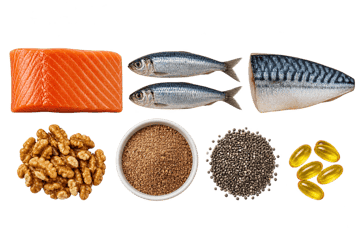
Fish in a usual week
 Salmon1828 mg EPA plus DHA in 3 oz4 oz
 Sardines835 mg EPA plus DHA in 3 oz0 oz
- Trout744 mg EPA plus DHA in 3 oz0 oz
 Tuna, canned light190 mg EPA plus DHA in 3 oz3 oz
7 oz a week. The US advice is at least 8 oz, two servings of 4 oz.
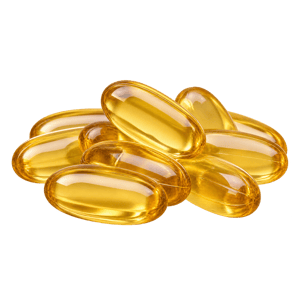
A fish oil capsule, from the back of the bottle
375 mgof EPA plus DHA a day
You're in or above the band the US fish advice gives. Fish does this without a capsule.
Plant omega-3 (ALA), on its own line
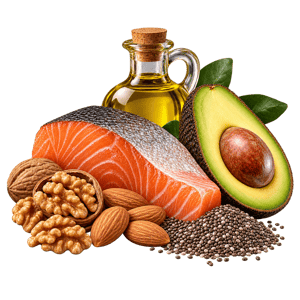
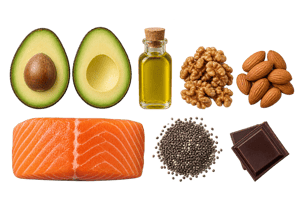
 Walnuts1 oz (14 halves): 2.5 g ALA0 a week
 Ground flaxseed1 tbsp: 1.6 g ALA0 a week
 Chia seeds1 oz: 5.1 g ALA0 a week
- Canola oil1 tbsp: 1.3 g ALA0 a week
0 g of ALA a day from these, against the Adequate Intake of 1.1 g. Oils, nuts and other foods add more.
Your body turns only a small part of ALA into EPA and DHA. In one tracer study of young women it was about 21% to EPA and 9% to DHA, and less in men. So the two are never added together here.
What your result means
- Inside the band, about 280 to 700 mg a day: you're eating what the US fish advice comes to. Keep it up.
- Under it: add a serving of salmon, sardines, trout or herring a week. The counter shows the ounces that close your gap.
- Capsules at 1,000 mg a day or more: in trials that gave more than 1 g a day, the risk of an irregular heartbeat was about half again higher. Talk to your doctor before you stay at that dose.
- Plant omega-3 (ALA): it counts on its own line, since your body turns only a small part of it into EPA and DHA.
- Pregnant or breastfeeding: 8 to 12 ounces a week from the FDA's lowest-mercury list. Which fish.
What 8 ounces a week gives, by fish
EPA plus DHA in 3 ounces of each fish, and what 8 ounces a week of it comes to a day: per 3 oz × 8 ÷ 3 ÷ 7.
| Fish | EPA plus DHA in 3 oz | 8 oz a week, per day |
|---|---|---|
| Salmon | 1.83 g | about 700 mg |
| Herring | 1.71 g | about 650 mg |
| Mackerel, Atlantic | 1.02 g | about 390 mg |
| Sardines | 0.84 g | about 320 mg |
| Trout | 0.74 g | about 280 mg |
| Tuna, white (albacore) | 0.73 g | about 280 mg |
| Tuna, canned light | 0.19 g | about 70 mg |
| Cod | 0.13 g | about 50 mg |
| Shrimp | 0.03 g | about 10 mg |
The US week of salmon, sardines or trout comes to about 280 to 700 mg a day. The fish you pick changes the omega-3 four to ten times.
Fish oil capsules
In heart trials, fish oil raised the risk of atrial fibrillation, an irregular heartbeat, by about a quarter, and by about half in trials over 1 g a day (Gencer 2021, 7 trials, 81,210 people). The counter flags any capsule total of 1,000 mg a day or more and never suggests a dose.
These are typical amounts. The Gyroscope app personalizes yours.
5 sources
- US Food and Drug Administration. Advice about Eating Fish. Revised October 2021fda.gov
- US Department of Agriculture. FoodData Central, SR Legacy, by FDC id: farmed Atlantic salmon (175168), canned Atlantic sardines (175139), farmed rainbow trout (173718), canned light tuna (173709), Atlantic herring (175117), Atlantic mackerel (175120), canned white tuna (175158), Atlantic cod (171956) and shrimp (175180)fdc.nal.usda.gov
- US Department of Agriculture and US Department of Health and Human Services. Dietary Guidelines for Americans, 2020 to 2025, Appendix 1, Table A1-2dietaryguidelines.gov
- Burdge GC, Wootton SA. Conversion of alpha-linolenic acid to eicosapentaenoic, docosapentaenoic and docosahexaenoic acids in young women. British Journal of Nutrition, 2002pubmed.ncbi.nlm.nih.gov
- Gencer B and others. Effect of long-term marine omega-3 fatty acids supplementation on the risk of atrial fibrillation in randomized controlled trials of cardiovascular outcomes. Circulation, 2021pmc.ncbi.nlm.nih.gov