What is the healthiest cooking oil?
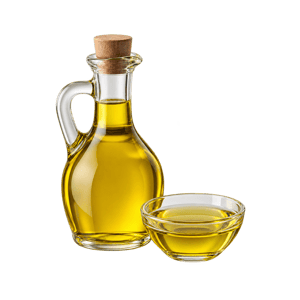
Extra virgin olive oil, for almost everything. It has 1.8 g of saturated fat a tablespoon, it smoked at 404 °F in a lab test of ten supermarket oils, and averaged over that test’s two heating runs it made the fewest breakdown compounds. Keep canola for baking and anything where you don’t want the taste.
“Healthiest oil” is really three questions people mix up. The first is what fats are in it, which decides what it does to your LDL. The second is how hot it gets before it smokes, and the third is how well it holds up when it’s heated for a long time. The smoke point is the number people quote, and in the one test that measured it beside breakdown, it predicted the least.
What we’d do: one bottle of extra virgin olive oil next to the stove for nearly everything, including frying at home, and a bottle of canola for baking. Keep butter and coconut oil for the places you taste them.
The three questions side by side
| Oil, 1 tbsp | Saturated fat (USDA) | Smoke point (one lab test) | Breakdown compounds after heating (same test) |
|---|---|---|---|
| Extra virgin olive oil | 1.8 g | 404 °F | 8.5% |
| Avocado | 1.6 g | 386 °F | 11.6% |
| Sunflower | 1.4 g | 490 °F | 15.6% |
| Canola | 1.0 g | 492 °F | 22.4% |
| Coconut | 11.2 g | 376 °F | 9.3% |
The breakdown column is polar compounds, the mix of damaged fat that builds up as oil cooks, averaged over the test’s two heating trials. The test came from an Australian lab, Modern Olives Laboratory Services, which belongs to an olive oil company, and it heated ten oils with no food in them. The authors say themselves that water from real food changes the chemistry.
What the test found
The surprise was that smoke point didn’t predict how an oil behaved. The oils with the highest smoke points, the refined seed oils, made the most breakdown compounds, and the authors found smoke point went up as performance went down. Averaged over both of their heating tests, extra virgin olive oil made the fewest, with coconut oil close behind. Canola, heated step by step up to 464 °F, reached 27.5% polar compounds, above the limits many countries set for frying oil.
Coconut oil’s good showing in the pan doesn’t make it a good everyday oil. It’s about 83% saturated, and in 16 trials it raised LDL by about 10 mg/dL against non-tropical plant oils.
The long view
In 221,054 US adults followed for up to 33 years, each extra 5 g a day of olive oil went with 8% fewer deaths and canola oil with 15% fewer. The 2026 US guidelines name olive oil first when you cook. Both oils lower LDL when they replace butter. Oil compare puts any two of 13 cooking fats side by side, and the oils guide covers frying.
- Saturated
- Monounsaturated
- Polyunsaturated
Coconut oil
11.2 g saturated a tablespoon
- Mono
- 0.9 g
- Poly
- 0.2 g
- Saturated share
- 83%
Smoked at 376 °F (191 °C) in one 2018 lab test of supermarket bottles.
The most saturated cooking fat, about 83%. Use it for flavor, not as your everyday oil.
Olive oil
1.8 g saturated a tablespoon
- Mono
- 9.9 g
- Poly
- 1.1 g
- Saturated share
- 13%
Smoked at 404 °F (207 °C) in one 2018 lab test of supermarket bottles (extra virgin 404 °F, olive 406 °F, virgin 348 °F).
Everyday cooking, roasting and dressing. In the test, extra virgin olive oil made the fewest breakdown compounds averaged over both heating runs, with coconut oil close behind.
The heat test
Deep frying usually tops out at 356 °F (180 °C). Averaged over both heating runs, extra virgin olive oil made the fewest breakdown compounds of the ten bottles, with coconut oil close behind, and canola the most. Smoke point didn't predict that. The lab was an olive oil company's (de Alzaa 2018), and the test bottles were Australian.
These are the US guideline's lines. The Gyroscope app personalizes yours.
8 sources
- de Alzaa, Guillaume and Ravetti, Evaluation of Chemical and Physical Changes in Different Commercial Oils during Heating, Acta Scientific Nutritional Health, 2018 (Modern Olives Laboratory Services, Australia)actascientific.com
- Gebhardt and Thomas, Nutritive Value of Foods, Home and Garden Bulletin 72, Table 9, USDA Agricultural Research Service, 2002ars.usda.gov
- USDA SR Legacy, Oil, coconut (FDC 171412), via NutritionValue.orgnutritionvalue.org
- USDA SR Legacy, Oil, avocado (FDC 173573), via NutritionValue.orgnutritionvalue.org
- Zhang et al., Butter and plant-based oils intake and mortality, JAMA Internal Medicine, 2025pmc.ncbi.nlm.nih.gov
- Neelakantan, Seah and van Dam, The effect of coconut oil consumption on cardiovascular risk factors, Circulation, 2020europepmc.org
- Fernandez and West, Mechanisms by which dietary fatty acids modulate plasma lipids, Journal of Nutrition, 2005europepmc.org
- US Department of Agriculture and US Department of Health and Human Services, Dietary Guidelines for Americans, 2025 to 2030, p. 3, January 2026cdn.realfood.gov