How much saturated fat is in butter?
On this page
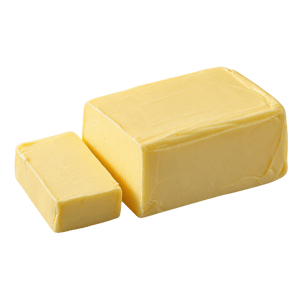
A tablespoon of butter has 7.2 g of saturated fat, about a third of the 22 g line for a 2,000 calorie day. A teaspoon has 2.5 g, and a whole stick has 57.3 g, more than two and a half days’ worth.
Butter looks like a small thing on a plate. It’s also one of the most saturated foods in the kitchen, since about 62% of its fat is saturated, and it often shows up twice a day, once in the pan and once on the toast.
What we’d do: keep butter where you taste it and cook in olive or canola oil. If you butter your toast, a teaspoon spread thin is 2.5 g. Two teaspoons in a pan is 5.0 g.
Butter by the spoon
| Butter (USDA) | Saturated fat | Share of a 2,000 calorie line |
|---|---|---|
| 1 teaspoon | 2.5 g | 11% |
| 1 tablespoon | 7.2 g | 32% |
| 1 stick (½ cup) | 57.3 g | 258% |
A tablespoon of butter weighs 14 g and has 12 g of fat. The rest is mostly water, about 16%. Of the fat, 7.2 g is saturated, 3.3 g monounsaturated and 0.4 g polyunsaturated. Butter also carries a little natural trans fat, which occurs in milk fat and wasn’t part of the FDA’s ban on partially hydrogenated oils.
On a smaller day, a tablespoon fills more of your line. It’s 43% of a 1,500 calorie day’s 17 g and 26% of a 2,500 calorie day’s 28 g.
Ghee
Ghee is butter with the water cooked out, so a tablespoon of it is almost all fat. The closest USDA row, anhydrous butter oil, has 7.9 g of saturated fat in a tablespoon (12.8 g), against butter’s 7.2 g in 14 g, so it’s the same fat packed a little tighter.
Next to the other fats
| A tablespoon | Saturated fat |
|---|---|
| Coconut oil | 11.2 g |
| Ghee | 7.9 g |
| Butter | 7.2 g |
| Lard | 5.0 g |
| Olive oil | 1.8 g |
| Canola oil | 1.0 g |
Swapping a daily tablespoon of butter for olive oil takes 5.4 g off your day, and for canola 6.2 g. In 221,054 US adults followed for up to 33 years, replacing 10 g of butter a day with plant oils went with 17% fewer deaths. The 2026 US guidelines list butter as an option, after “oils with essential fatty acids, such as olive oil,” and keep saturated fat under 10% of calories in the same paragraph. Is butter worse than olive oil? has the full comparison.
- Saturated
- Monounsaturated
- Polyunsaturated
Coconut oil
11.2 g saturated a tablespoon
- Mono
- 0.9 g
- Poly
- 0.2 g
- Saturated share
- 83%
Smoked at 376 °F (191 °C) in one 2018 lab test of supermarket bottles.
The most saturated cooking fat, about 83%. Use it for flavor, not as your everyday oil.
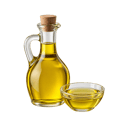
Olive oil
1.8 g saturated a tablespoon
- Mono
- 9.9 g
- Poly
- 1.1 g
- Saturated share
- 13%
Smoked at 404 °F (207 °C) in one 2018 lab test of supermarket bottles (extra virgin 404 °F, olive 406 °F, virgin 348 °F).
Everyday cooking, roasting and dressing. In the test, extra virgin olive oil made the fewest breakdown compounds averaged over both heating runs, with coconut oil close behind.
The heat test
Deep frying usually tops out at 356 °F (180 °C). Averaged over both heating runs, extra virgin olive oil made the fewest breakdown compounds of the ten bottles, with coconut oil close behind, and canola the most. Smoke point didn't predict that. The lab was an olive oil company's (de Alzaa 2018), and the test bottles were Australian.
These are the US guideline's lines. The Gyroscope app personalizes yours.
5 sources
- Gebhardt and Thomas, Nutritive Value of Foods, Home and Garden Bulletin 72, Table 9, items 151 to 153, USDA Agricultural Research Service, 2002ars.usda.gov
- USDA SR Legacy, Butter oil, anhydrous (FDC 173412), via NutritionValue.orgnutritionvalue.org
- US Food and Drug Administration, Trans Fatfda.gov
- US Department of Agriculture and US Department of Health and Human Services, Dietary Guidelines for Americans, 2025 to 2030, p. 3, January 2026cdn.realfood.gov
- Zhang et al., Butter and plant-based oils intake and mortality, JAMA Internal Medicine, 2025pmc.ncbi.nlm.nih.gov