Is canola oil bad for you?
No. Canola oil has 1.0 g of saturated fat a tablespoon, about a seventh of butter’s, and in a US study that followed 221,054 adults for up to 33 years, each extra 5 g a day of canola oil went with 15% fewer deaths. Its one real weakness is long frying, where it broke down more than olive oil in a lab test.
Canola is the oil people throw out first when they hear seed oils are toxic. The case against it usually comes in three parts: the omega-6 in it causes inflammation, it’s industrially processed, and it goes bad when heated. The first claim has been tested in people and didn’t hold up. The third is partly true, and it’s the reason for the one change we’d make.
What we’d do: keep canola for baking, dressings and everyday cooking where you want no taste, and use extra virgin olive oil for long, hot frying. Don’t reuse any frying oil for days.
What’s in a tablespoon
| A tablespoon (USDA) | Canola | Olive oil | Butter |
|---|---|---|---|
| Saturated | 1.0 g | 1.8 g | 7.2 g |
| Monounsaturated | 8.2 g | 9.9 g | 3.3 g |
| Polyunsaturated | 4.1 g | 1.1 g | 0.4 g |
Of canola’s polyunsaturated fat, 2.6 g is linoleic acid, an omega-6, and 1.3 g is alpha-linolenic acid, the plant omega-3. That’s more plant omega-3 than a woman’s whole daily Adequate Intake of 1.1 g, from one spoon. Of the oils in the USDA table, only high oleic safflower oil, at 0.8 g, has less saturated fat.
The inflammation claim
The worry is that omega-6 fats turn into inflammatory compounds in the body, and that’s been tested in people. In 15 randomized trials in healthy people, eating more linoleic acid didn’t raise C-reactive protein or any other inflammation marker the researchers measured. And across 30 studies in 13 countries with 68,659 people, those with more linoleic acid in their blood had fewer heart events and fewer cardiovascular deaths. Are seed oils bad for you? takes the rest of the claims one at a time.
The frying result
In 2018, an Australian lab owned by an olive oil company heated ten supermarket oils. Canola had one of the highest smoke points, 492 °F, but averaged over two heating runs it made the most breakdown compounds of all ten. Heated step by step up to 464 °F, it reached 27.5% polar compounds, above the limits many countries set for frying oil. Extra virgin olive oil made the fewest on that average. No food was cooked, and the lab had an interest in the result, but the pattern matches canola’s chemistry, since polyunsaturated fat breaks down faster with heat.
The long view
The 2020 to 2025 US guidelines list canola among the oils to cook with in place of butter, shortening, coconut or palm oil. In the 221,054-person study, canola had a stronger link with fewer deaths than olive oil (8% fewer per 5 g a day) or soybean oil (6%). That study followed people rather than assigning oils, so it can’t prove cause.
- Saturated
- Monounsaturated
- Polyunsaturated
Coconut oil
11.2 g saturated a tablespoon
- Mono
- 0.9 g
- Poly
- 0.2 g
- Saturated share
- 83%
Smoked at 376 °F (191 °C) in one 2018 lab test of supermarket bottles.
The most saturated cooking fat, about 83%. Use it for flavor, not as your everyday oil.
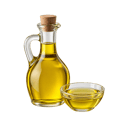
Olive oil
1.8 g saturated a tablespoon
- Mono
- 9.9 g
- Poly
- 1.1 g
- Saturated share
- 13%
Smoked at 404 °F (207 °C) in one 2018 lab test of supermarket bottles (extra virgin 404 °F, olive 406 °F, virgin 348 °F).
Everyday cooking, roasting and dressing. In the test, extra virgin olive oil made the fewest breakdown compounds averaged over both heating runs, with coconut oil close behind.
The heat test
Deep frying usually tops out at 356 °F (180 °C). Averaged over both heating runs, extra virgin olive oil made the fewest breakdown compounds of the ten bottles, with coconut oil close behind, and canola the most. Smoke point didn't predict that. The lab was an olive oil company's (de Alzaa 2018), and the test bottles were Australian.
These are the US guideline's lines. The Gyroscope app personalizes yours.
7 sources
- Gebhardt and Thomas, Nutritive Value of Foods, Home and Garden Bulletin 72, Table 9, USDA Agricultural Research Service, 2002ars.usda.gov
- USDA SR Legacy, Oil, canola (FDC 172336), via NutritionValue.orgnutritionvalue.org
- Zhang et al., Butter and plant-based oils intake and mortality, JAMA Internal Medicine, 2025pmc.ncbi.nlm.nih.gov
- Johnson and Fritsche, Effect of dietary linoleic acid on markers of inflammation in healthy persons: a systematic review of randomized controlled trials, Journal of the Academy of Nutrition and Dietetics, 2012europepmc.org
- Marklund et al., Biomarkers of dietary omega-6 fatty acids and incident cardiovascular disease and mortality (FORCE), Circulation, 2019europepmc.org
- de Alzaa, Guillaume and Ravetti, Evaluation of Chemical and Physical Changes in Different Commercial Oils during Heating, Acta Scientific Nutritional Health, 2018 (Modern Olives Laboratory Services, Australia)actascientific.com
- US Department of Agriculture and US Department of Health and Human Services, Dietary Guidelines for Americans, 2020 to 2025, p. 44, 2020dietaryguidelines.gov