How much fat a day?
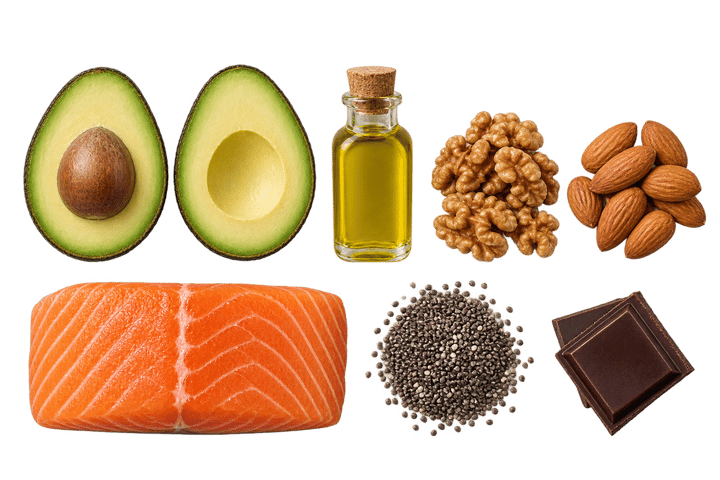
20 to 35% of your calories, for adults. The range is wide on purpose. Inside it, the kind of fat matters more than the total.
Not sure? tdee.guide works out yours from your steps. Food labels use 2,000.
44to78grams of fat a day, 20 to 35% of 2,000 calories
Inside it, saturated fat under 22.2 g. The kind matters more than the total.
The band is wide on purpose. Both of those days sit in it. In a 609-person, 12-month trial, a healthy low-fat and a healthy low-carb diet lost about the same weight: 5.3 kg against 6.0 kg (DIETFITS, Gardner 2018).
The floor: fats your body can't make
- Linoleic acid (omega-6)
- 12 g a day
- Alpha-linolenic acid (omega-3)
- 1.1 g a day
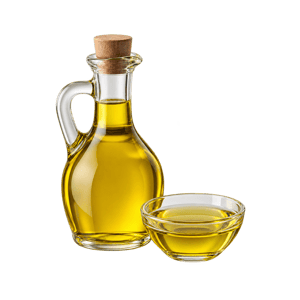
- A tablespoon of corn oil has 8 g of polyunsaturated fat, most of it linoleic acid (7.5 g).
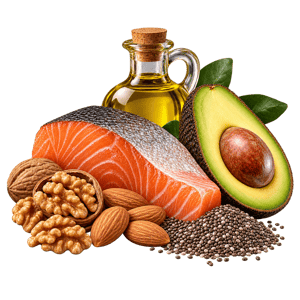
- An ounce of walnuts has 2.5 g of alpha-linolenic acid, and 10.7 g of linoleic acid.
- A tablespoon of ground flaxseed has 1.6 g of alpha-linolenic acid, a tablespoon of canola oil 1.3 g.
Adequate Intakes from the US guidelines' table of nutrient goals. They're a floor, not a target.
 Saturated
 Monounsaturated
 Polyunsaturated
These are the US guideline's lines. The Gyroscope app personalizes yours.
What your result means
- Your day lands inside the band: the total is fine, and the kind of fat counts for more. Check your saturated fat against the smaller band inside it.
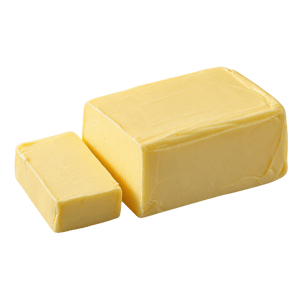
- Above 35%: common on low carb and keto. The US range stops at 35%, and in the DIETFITS trial a diet with 45% of calories from fat lost about the same weight as one with 29%. If you eat this much fat, make most of it the kind that pours, so saturated fat stays under its line.
- Below 20%: check you still get the two essential fats listed under the band. A tablespoon of canola oil has 1.3 g of alpha-linolenic acid, more than a woman's 1.1 g Adequate Intake.
Fat has 9 calories a gram, so the grams here count toward your calories like any others. Does eating fat make you fat?
The band at common calorie levels
Total fat at 20 to 35% of calories: calories × 0.20 ÷ 9 to calories × 0.35 ÷ 9. Saturated fat under 10%.
| Calories a day | Total fat | Saturated fat line |
|---|---|---|
| 1,200 | 27 to 47 g | 13 g |
| 1,500 | 33 to 58 g | 17 g |
| 1,800 | 40 to 70 g | 20 g |
| 2,000 | 44 to 78 g | 22 g |
| 2,200 | 49 to 86 g | 24 g |
| 2,500 | 56 to 97 g | 28 g |
| 3,000 | 67 to 117 g | 33 g |
Where the range comes from
The 20 to 35% is the Acceptable Macronutrient Distribution Range in the 2020 to 2025 US guidelines. The 2025 to 2030 guidelines set no total fat range, and keep saturated fat under 10% of calories.
The essential fats
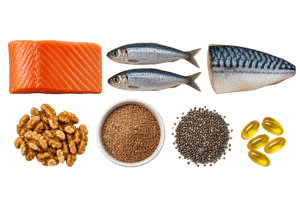
Two fats your body can't make: linoleic acid (omega-6) and alpha-linolenic acid (plant omega-3). Both are polyunsaturated. The US Adequate Intakes are 12 g of linoleic acid for women 19 to 50 and 17 g for men, 11 g and 14 g from 51 on, and 1.1 g of alpha-linolenic acid for women and 1.6 g for men.
These are typical ranges, not a prescription. The Gyroscope app personalizes yours.
5 sources
- US Department of Agriculture and US Department of Health and Human Services. Dietary Guidelines for Americans, 2020 to 2025, Appendix 1, Table A1-2, p. 133dietaryguidelines.gov
- US Department of Agriculture and US Department of Health and Human Services. Dietary Guidelines for Americans, 2025 to 2030, p. 3cdn.realfood.gov
- US Food and Drug Administration. Daily Value on the Nutrition and Supplement Facts Labelsfda.gov
- Gardner CD and others. Effect of low-fat vs low-carbohydrate diet on 12-month weight loss in overweight adults (DIETFITS). JAMA, 2018pmc.ncbi.nlm.nih.gov
- US Department of Agriculture. FoodData Central, SR Legacy (corn oil 171029, walnuts 170187, flaxseed 169414, canola oil 172336)fdc.nal.usda.gov