How much fish should I eat while pregnant?
On this page
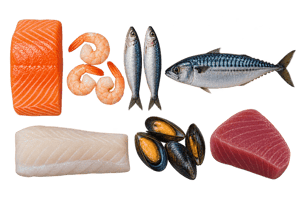
The FDA’s advice is 8 to 12 ounces of fish a week while you’re pregnant or breastfeeding. That’s 2 to 3 servings of 4 ounces from its Best Choices list, the fish lowest in mercury, or 1 serving from its Good Choices list. Salmon, sardines and trout are Best Choices, and they bring the most omega-3 of the fish people usually buy.
Plenty of people cut fish out completely when they find out they’re pregnant, because mercury is the one thing they’ve heard about it. The FDA’s advice goes the other way. It says fish give a baby nutrients for brain development, including the omega-3 fats DHA and EPA, and that “moderate scientific evidence” shows eating fish in pregnancy can help a baby’s cognitive development. The 2026 US Dietary Guidelines also name “low-mercury omega-3–rich seafood (e.g., salmon, sardines, trout)” for pregnant women.
What we’d do: two or three palm-sized servings a week of salmon, sardines, trout or herring. They’re all low in mercury and high in omega-3. Canned light tuna counts toward the ounces, but it brings very little omega-3. The FDA’s own measure for a serving is the palm of your hand, which is about 4 ounces for an adult.
Which fish are on the lowest-mercury list?
The Best Choices list is long, and most of the fish in a supermarket are on it. Among them are salmon, sardines, freshwater trout, herring, anchovies, Atlantic mackerel, cod, haddock, pollock, tilapia, catfish, flounder, sole, shrimp, scallops, crab, clams, oysters and canned light tuna (skipjack included).
The Good Choices list is for one serving a week, with no other fish that week. It includes albacore (white) tuna, canned or fresh, yellowfin tuna, halibut, mahi mahi, snapper, grouper, striped bass, Spanish mackerel and Chilean sea bass.
Seven fish are the ones to skip, since they carry the most mercury: king mackerel, marlin, orange roughy, shark, swordfish, tilefish from the Gulf of Mexico and bigeye tuna.
Which fish bring the most omega-3?
Low in mercury and high in omega-3 are two different lists, and they only partly overlap. Cod and shrimp are Best Choices, but 8 ounces a week of either gives you almost no EPA or DHA. Salmon gives you about ten times what canned light tuna does.
8 ounces a week of one fish gives you, a day
-
 Salmon, farmedBest Choice 700 mg
- HerringBest Choice 650 mg
-
 Mackerel, AtlanticBest Choice 390 mg
-
 SardinesBest Choice 320 mg
- TroutBest Choice 280 mg
-
 Tuna, albacore 280 mg
- Tuna, canned lightBest Choice 72 mg
-
 CodBest Choice 51 mg
-
 ShrimpBest Choice 10 mg
At 12 ounces a week, the top of the FDA’s range, farmed salmon comes to about 1,000 mg of EPA and DHA a day and sardines about 480 mg. Mixing the two over a week lands you between those.
What about fish oil capsules?
The FDA’s fish advice doesn’t cover supplements, and the 2026 guidelines say to talk to your health care professional about a daily prenatal vitamin. Whether you need a fish oil or algae oil capsule on top of the fish is a question for your midwife or doctor. The omega-3 counter below has a pregnancy switch, and it doesn’t work out capsule doses in pregnancy.
Fish someone caught for you
Larger carp, catfish, trout and perch from local waters are more likely to carry mercury or other contaminants. The FDA says to check for a local fish advisory first, and if there isn’t one, to eat only one serving of that fish and no other fish that week.
Breastfeeding and young children
The same 8 to 12 ounces a week applies while you’re breastfeeding. For children, the FDA suggests 2 servings a week from the Best Choices list, with smaller servings by age: about 1 ounce at age 1 to 3, 2 ounces at 4 to 7, 3 ounces at 8 to 10 and 4 ounces from 11. When the advice changes covers the other times the fat advice is different, and which fish has the most omega-3? ranks the common fish.
Fish in a usual week
 Salmon1828 mg EPA plus DHA in 3 oz4 oz
 Sardines835 mg EPA plus DHA in 3 oz0 oz
- Trout744 mg EPA plus DHA in 3 oz0 oz
 Tuna, canned light190 mg EPA plus DHA in 3 oz3 oz
7 oz a week. The US advice is at least 8 oz, two servings of 4 oz.
A fish oil capsule, from the back of the bottle
375 mgof EPA plus DHA a day
You're in or above the band the US fish advice gives. Fish does this without a capsule.
Plant omega-3 (ALA), on its own line
 Walnuts1 oz (14 halves): 2.5 g ALA0 a week
 Ground flaxseed1 tbsp: 1.6 g ALA0 a week
 Chia seeds1 oz: 5.1 g ALA0 a week
- Canola oil1 tbsp: 1.3 g ALA0 a week
0 g of ALA a day from these, against the Adequate Intake of 1.1 g. Oils, nuts and other foods add more.
Your body turns only a small part of ALA into EPA and DHA. In one tracer study of young women it was about 21% to EPA and 9% to DHA, and less in men. So the two are never added together here.
6 sources
- US Food and Drug Administration, Advice about Eating Fish: for those who might become or are pregnant or breastfeeding and children ages 1 to 11 years, advice revised October 2021, content current as of March 5, 2024fda.gov
- US Department of Agriculture and US Department of Health and Human Services, Dietary Guidelines for Americans, 2025 to 2030, p. 8 (pregnant women), January 2026cdn.realfood.gov
- USDA SR Legacy, Fish, salmon, Atlantic, farmed, cooked (FDC 175168), via NutritionValue.orgnutritionvalue.org
- USDA SR Legacy, Fish, sardine, Atlantic, canned in oil (FDC 175139), via NutritionValue.orgnutritionvalue.org
- USDA SR Legacy, Fish, rainbow trout, farmed, cooked (FDC 173718), via NutritionValue.orgnutritionvalue.org
- USDA SR Legacy, Fish, light tuna, canned in water (FDC 173709), via NutritionValue.orgnutritionvalue.org