
When the advice changes
On this page
On keto, keep the carbs low and change the fat. On a vegan diet, add algae oil to flax, chia and walnuts. In pregnancy, eat 8 to 12 ounces a week of low-mercury fish. Young children need full-fat dairy.
Most fat advice is written for one imaginary average adult. Real people are on keto, or vegan, or pregnant, or feeding a toddler, or doing everything right and still getting a high cholesterol result. Each of them needs the same basics with one or two changes.
What we’d do
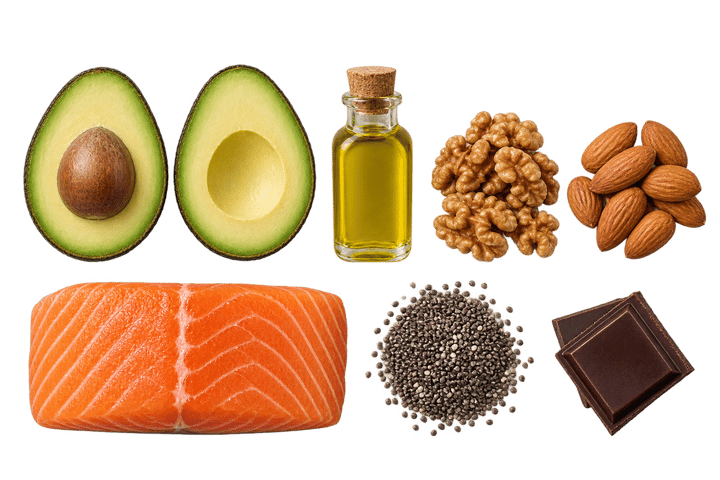
On keto, keep the carbs low and change the fat, with olive oil, avocado, nuts and fish in place of butter, cream and fatty meat. On a vegan diet, eat flax, chia or walnuts every day and think about algae oil. In pregnancy, eat 8 to 12 ounces a week of low-mercury fish.
If your LDL stays high on a good diet, or you take a statin, the food changes still help, and your doctor decides the rest. Never stop a cholesterol medicine on your own.
If you remember three things
- Keto can raise LDL a lot in some people, mostly when it’s built on animal fat. A keto day can carry more fat and less saturated fat.
- Vegans can get plant omega-3 easily. EPA and DHA need algae oil.
- Pregnant or breastfeeding, the FDA’s advice is 2 to 3 servings a week of fish from its Best Choices list.
On a keto or very low carb diet
The newest US cholesterol guideline, from March 2026, says ketogenic diets bring “significant short-term weight and TG reduction”, meaning triglycerides. It also says “LDL-C can be increased substantially in some individuals, particularly when there is high consumption of animal products.” It lists ketosis among the things that can push LDL up.
You can keep the carbs low and change which fat fills the plate. Here are two keto days with almost no carbs, from the USDA’s tables.
| Day | What’s in it | Total fat | Saturated | The split |
|---|---|---|---|---|
| Butter keto | 2 tablespoons of butter in the pan, 2 tablespoons of heavy cream, 3 oz of 73% lean beef, 2 oz of cheddar, 3 slices of bacon, 3 eggs | 96 g | 48.4 g | |
| Olive keto | 2 tablespoons of olive oil in the pan, the same cream and eggs, 3 oz of 93% lean beef, 1 oz of cheddar, 2 oz of avocado, 1 oz of almonds, 3 oz of salmon | 106 g | 29.1 g |
- Saturated
- Monounsaturated
- Polyunsaturated
- Trans
The second day has more fat than the first, and about 19 g less saturated fat. It’s still a keto day. Whether it brings your LDL back down is something only a blood test can tell you, since people respond very differently on keto. cholesterol.guide covers the LDL side, and Why is my LDL high on keto? covers the food side.
On a vegan diet
The plant omega-3, ALA, is easy. A tablespoon of ground flaxseed has 1.6 g, an ounce of walnuts 2.5 g and an ounce of chia seeds 5.1 g, against a US Adequate Intake of 1.1 g a day for women and 1.6 g for men.
EPA and DHA are harder. Your body turns only a little ALA into them. In young women given 700 mg of labeled ALA, about 21% became EPA and 9% DHA, and a review of these studies found the conversion “limited” in men, with very little reaching DHA.
Algae oil skips that step. EPA and DHA start in algae in the first place, and fish only collect them. How do vegans get omega-3? goes through the options.
Saturated fat is rarely the problem on a vegan diet, with one exception. Cooking everything in coconut oil can put a vegan over the line, since one tablespoon has 11.2 g.
In pregnancy and breastfeeding
The FDA’s advice is 8 to 12 ounces a week of seafood lower in mercury, which is 2 to 3 servings of 4 ounces from its Best Choices list, or 1 serving from its Good Choices list. Salmon, sardines and freshwater trout are Best Choices. Avoid the highest mercury fish: king mackerel, marlin, orange roughy, shark, swordfish, bigeye tuna and tilefish from the Gulf of Mexico.
The 2026 Dietary Guidelines say pregnant women should eat “low-mercury omega-3–rich seafood (e.g., salmon, sardines, trout)”. Fish oil capsules in pregnancy are a question for your midwife or doctor, and the tools on this site don’t work out capsule doses for pregnancy.
For children
The 2026 Dietary Guidelines say “full-fat dairy products are important for children to help meet energy needs and support brain development.” The FDA’s fish advice says children should eat less seafood than the adult 8 ounces. The saturated fat line and the numbers on this site are for adults.
When your LDL stays high on a good diet
Some people eat well and still have high LDL. Food is one cause among several. The 2026 US cholesterol guideline lists others that can push LDL up, including an underactive thyroid, rapid weight loss, ketosis, pregnancy, some medicines, and the years around menopause. Genes are another, and a very high LDL from birth needs a doctor, whatever you eat.
The fat swap still helps in all of these, and it adds to any medicine you take. If you take a statin, keep taking it. A statin is never stopped on your own. cholesterol.guide explains the numbers and when to see a doctor.
On a GLP-1 medicine
The food advice here still holds on a GLP-1 drug such as semaglutide or tirzepatide. bodyfat.guide covers eating on these medicines in detail, and any change to the dose is your prescriber’s call.
8 sources
- Blumenthal and others, 2026 ACC/AHA/multisociety Guideline on the Management of Dyslipidemia, Circulation, March 2026, section 4.1 and Table 15api.iscpcardio.org
- Gebhardt and Thomas, Nutritive Value of Foods, Home and Garden Bulletin 72, Table 9, USDA Agricultural Research Service, 2002ars.usda.gov
- US Department of Agriculture and US Department of Health and Human Services, Dietary Guidelines for Americans, 2020 to 2025, Appendix 1 Table A1-2, December 2020dietaryguidelines.gov
- US Department of Agriculture and US Department of Health and Human Services, Dietary Guidelines for Americans, 2025 to 2030, pp. 7 to 8, January 2026cdn.realfood.gov
- Burdge and Wootton, Conversion of alpha-linolenic acid to eicosapentaenoic, docosapentaenoic and docosahexaenoic acids in young women, British Journal of Nutrition, 2002pubmed.ncbi.nlm.nih.gov
- Burdge and Calder, Conversion of alpha-linolenic acid to longer-chain polyunsaturated fatty acids in human adults, Reproduction Nutrition Development, 2005pubmed.ncbi.nlm.nih.gov
- Doughman, Krupanidhi and Sanjeevi, Omega-3 fatty acids for nutrition and medicine: considering microalgae oil as a vegetarian source of EPA and DHA, Current Diabetes Reviews, 2007pubmed.ncbi.nlm.nih.gov
- US Food and Drug Administration, Advice about Eating Fish, content current as of March 5, 2024fda.gov