How much fat, and how much saturated fat?
On this page
Keep saturated fat under 10% of your calories, about 22 g on 2,000 calories. Total fat can sit anywhere from 20 to 35%, about 44 to 78 g. The 20 g on a food label is a fixed number, so your own line can be lower or higher than it.
Most people look at the Nutrition Facts panel, see “Saturated Fat 20 g” as the daily amount, and treat it as their limit. It isn’t anyone’s limit in particular. The FDA’s Daily Values are one set of numbers printed for everyone, while the guidelines’ line is a share of your own calories. On 1,500 calories the label’s 20 g is 12% of your day, over the line. On 2,500 calories it’s 7%.
What we’d do
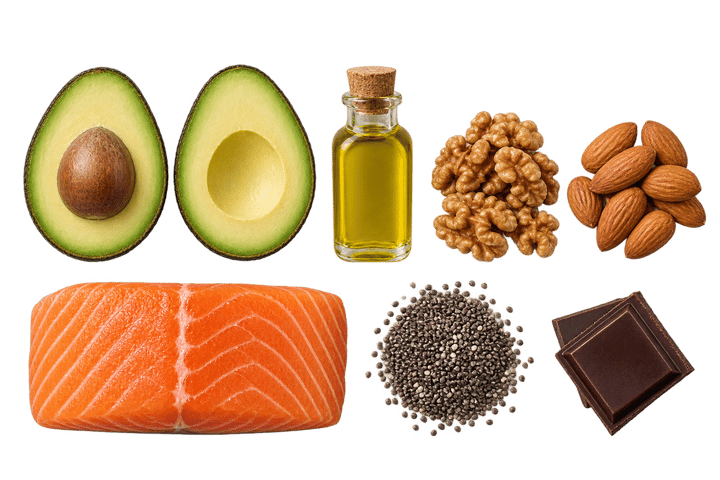
Work out your own saturated fat line once, from your calories, and keep that number in your head instead of the label’s. Then spend most of your fat on oils, nuts, seeds, avocado and fish.
Don’t chase a total fat number. The range is wide on purpose, and people did well at both ends of it. The number to watch is saturated grams.
If you remember three things
- Your line is your calories × 10% ÷ 9. About 17 g on 1,500 calories, 22 g on 2,000 and 28 g on 2,500.
- The label’s 20 g never moves. It can be more than your line or less, depending on how much you eat.
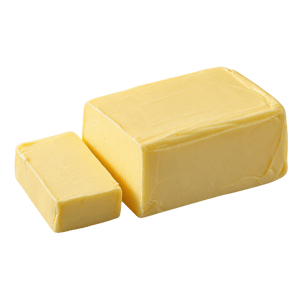
- A tablespoon of butter is a third of a 2,000 calorie line. A tablespoon of coconut oil is half.
Where does the 10% come from?
The 2025 to 2030 US Dietary Guidelines say “saturated fat consumption should not exceed 10% of total daily calories”. Fat has 9 calories a gram, so the arithmetic is short. Multiply your calories by 0.10 to get the calories you can spend on saturated fat, then divide by 9 for grams. On 2,000 calories that’s 200 calories, or about 22 g.
Total fat comes from the older 2020 to 2025 edition, since the new one sets no range. For adults it’s 20 to 35% of calories, the Acceptable Macronutrient Distribution Range.
| Your calories | Saturated fat line (10%) | Total fat (20 to 35%) |
|---|---|---|
| 1,200 | 13 g | 27 to 47 g |
| 1,500 | 17 g | 33 to 58 g |
| 1,800 | 20 g | 40 to 70 g |
| 2,000 | 22 g | 44 to 78 g |
| 2,200 | 24 g | 49 to 86 g |
| 2,500 | 28 g | 56 to 97 g |
| 3,000 | 33 g | 67 to 117 g |
These are the US guideline’s lines. The Gyroscope app personalizes yours. If you don’t know your calories, tdee.guide works them out from your steps, and the saturated fat tool turns them into grams.
What does 22 grams look like?
It’s less food than people expect. Each of these is one ordinary portion, and its share of a 2,000 calorie line.
| Food | Portion | Saturated | Share of 22 g |
|---|---|---|---|
| Coconut oil | 1 tablespoon | 11.2 g | 50% |
| Butter | 1 tablespoon | 7.2 g | 32% |
| Ground beef, 73% lean | 3 oz cooked | 6.9 g | 31% |
| Butter croissant | 1 | 6.6 g | 30% |
| Cheddar | 1 oz | 6.0 g | 27% |
| Whole milk | 1 cup | 5.1 g | 23% |
| Vanilla ice cream | ½ cup | 4.5 g | 20% |
| Olive oil | 1 tablespoon | 1.8 g | 8% |
| Egg | 1 large | 1.6 g | 7% |
Here’s a day most people wouldn’t think twice about. Two eggs cooked in a tablespoon of butter, a sandwich with an ounce of cheddar, a 3 oz burger made with 83% lean beef and a cup of whole milk. That’s 27.0 g of saturated fat, 12% of 2,000 calories and over the 22 g line.
The biggest single source is the butter in the pan. Cook the eggs in olive oil instead and the day drops to 21.6 g, under the line, with nothing else changed.
The bar is the day as eaten. The paler bar inside it is the same day with olive oil in the pan. The fat scorer does this for any day you build, and finds the swap that takes off the most.
Why is the total fat range so wide?
People have done well at both ends of it. In the DIETFITS trial, 609 adults spent a year on either a healthy low-fat diet or a healthy low-carb one. The low-fat group got 29% of its calories from fat and the low-carb group 45%. After 12 months they’d lost about the same, 5.3 kg against 6.0 kg (about 12 and 13 pounds).
The range has a floor for a reason, though. Two fats are essential, since your body can’t make them. The guidelines set an Adequate Intake of linoleic acid (omega-6) at 12 g a day for women 19 to 50 and 17 g for men 19 to 50, a little less after 50, and of alpha-linolenic acid (plant omega-3) at 1.1 g for women and 1.6 g for men. A day of almost no fat makes those hard to reach. How much fat a day? shows your band with the floor under it.
What did the 2026 guidelines change?
The January 2026 Dietary Guidelines got a lot of attention for their wording on fat. Here’s what they say.
- They kept the 10% line. “In general, saturated fat consumption should not exceed 10% of total daily calories.”
- They put olive oil first, and butter after it. “When cooking with or adding fats to meals, prioritize oils with essential fatty acids, such as olive oil. Other options can include butter or beef tallow.”
- They welcomed full-fat dairy. “When consuming dairy, include full-fat dairy with no added sugars,” with a goal of three servings a day at 2,000 calories.
- They set no total fat range, and named no seed oils, for or against.
- They said the science isn’t finished. “More high-quality research is needed to determine which types of dietary fats best support long-term health.”
The full-fat dairy line and the 10% line pull against each other. Three cups of whole milk hold 15.3 g of saturated fat, about 70% of a 2,000 calorie day’s line, before any butter or cheese. The full-fat dairy myth works through it.
More detail: the label’s Daily Values
The FDA’s Daily Values for fat are 78 g of total fat and 20 g of saturated fat. There’s no Daily Value for trans fat. The FDA says 5% of the Daily Value or less in a serving is low and 20% or more is high. A serving with 4 g of saturated fat is “20% DV”, high by the label’s own rule.
The Daily Values don’t change with your calories. The guidelines’ line does: calories × 0.10 ÷ 9 for saturated fat, and calories × 0.20 ÷ 9 to calories × 0.35 ÷ 9 for total fat.
6 sources
- US Department of Agriculture and US Department of Health and Human Services, Dietary Guidelines for Americans, 2025 to 2030, pp. 2 to 3, January 2026cdn.realfood.gov
- US Department of Agriculture and US Department of Health and Human Services, Dietary Guidelines for Americans, 2020 to 2025, p. 44 and Appendix 1 Table A1-2, December 2020dietaryguidelines.gov
- US Food and Drug Administration, Daily Value on the Nutrition and Supplement Facts Labelsfda.gov
- Gebhardt and Thomas, Nutritive Value of Foods, Home and Garden Bulletin 72, Table 9, USDA Agricultural Research Service, 2002ars.usda.gov
- USDA FoodData Central SR Legacy, Oil, coconut (FDC 171412), as listed on NutritionValue.orgnutritionvalue.org
- Gardner and others, Effect of low-fat vs low-carbohydrate diet on 12-month weight loss in overweight adults (DIETFITS), JAMA, 2018pmc.ncbi.nlm.nih.gov