Where the saturated fat in your day comes from
On this page
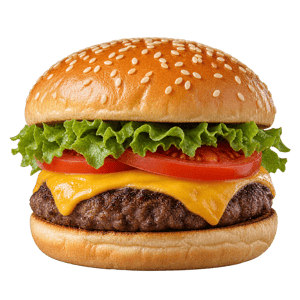
In US diets the most saturated fat comes from sandwiches and burgers, then desserts and sweet snacks, then rice, pasta and other mixed dishes. In one person’s day it usually comes down to one or two foods eaten every day.
Ask people where their saturated fat comes from and they’ll say steak and bacon. Those count, but a lean steak has less than people think, and the big sources are often the quiet ones: the butter in the pan every morning, the cheese on everything, a pastry with coffee. The average American gets 11% of their calories from saturated fat, and only 23% of people stay under the 10% line.
What we’d do
Don’t overhaul your whole diet. Find your one biggest source and change that first. For most people it’s the cooking fat, the cheese or the pastry, and one swap gets them most of the way to the line.
The fat scorer finds it for a day of food, and the personalized guide finds it for a usual week in seven taps.
If you remember three things
- Sandwiches and burgers carry the most saturated fat in US diets, about a fifth of it.
- An ounce of cheddar has 6.0 g, more than twice a 3 oz lean sirloin steak.
- Your own day usually has one big source. Change it and the rest often fits.
Where does America’s saturated fat come from?
The US guidelines broke down where the saturated fat in American diets comes from, using national food surveys from 2013 to 2016 of everyone aged 1 and older. The average was 239 calories of saturated fat a day, about 27 g.
| Food group | Share of saturated fat |
|---|---|
| Sandwiches, including burgers, tacos and burritos | 19% |
| Desserts and sweet snacks | 11% |
| Rice, pasta and other grain-based mixed dishes | 7% |
| Higher fat milk and yogurt | 6% |
| Pizza | 5% |
| Cheese on its own | 4% |
| Everything else, in small slices | the rest |
The list explains why the swap advice can feel useless. Nobody eats “grain-based mixed dishes”. They eat lasagna, burritos and mac and cheese, and the saturated fat in them comes from the cheese, the meat and the butter that went in. The guidelines’ own advice for adults is to change the ingredients of those dishes, with leaner meat, lower fat cheese or beans, rather than give the dishes up.
Men and women differ too. The average man eats about 290 calories of saturated fat a day, about 32 g, and the average woman about 210 calories, about 23 g. More than 70% of adults are over the line.
Which foods have the most?
One ordinary portion of each, from the USDA’s tables, in order.
| Food | Portion | Saturated | The split |
|---|---|---|---|
| Coconut oil | 1 tablespoon | 11.2 g | |
| Butter | 1 tablespoon | 7.2 g | |
| Ground beef, 73% lean | 3 oz cooked | 6.9 g | |
| Butter croissant | 1 | 6.6 g | |
| Cheeseburger | 1 | 6.3 g | |
| Cheddar | 1 oz | 6.0 g | |
| Ground beef, 83% lean | 3 oz cooked | 5.5 g | |
| Whole milk | 1 cup | 5.1 g | |
| Vanilla ice cream | ½ cup | 4.5 g | |
| Heavy cream | 1 tablespoon | 3.5 g | |
| Bacon | 3 slices | 3.3 g | |
| Sirloin steak, lean | 3 oz cooked | 2.4 g | |
| Peanut butter | 1 tablespoon | 1.7 g | |
| Egg | 1 large | 1.6 g | |
| Almonds | 1 oz | 1.1 g | |
| Avocado | 1 oz | 0.7 g |
- Saturated
- Monounsaturated
- Polyunsaturated
- Trans
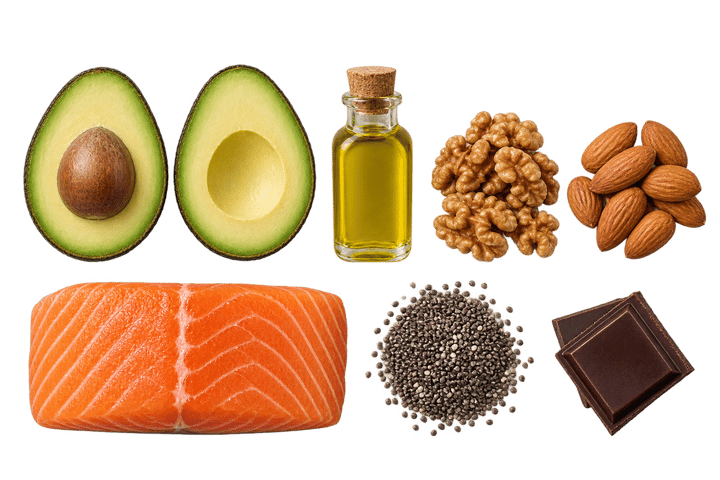
The bars are the whole fat in each portion. An ounce of almonds has as much fat as a tablespoon of olive oil, about 14 g, and only 1.1 g of it is saturated. Three ounces of cooked 73% lean ground beef has about 18 g of fat, with 6.9 g of it saturated.
Two things surprise people here. A lean sirloin steak has less saturated fat than a single ounce of cheddar. And an egg has 1.6 g, about as much as a tablespoon of olive oil. Eggs come up mostly because of the cholesterol in the yolk, which is a separate question that cholesterol.guide answers.
What does one person’s day look like?
Take a day of food a lot of people would recognize. A butter croissant in the morning, a fast food cheeseburger and a small fries at lunch, two slices of a 12 inch cheese pizza at dinner, and half a cup of ice cream after. That’s 23.7 g of saturated fat, just over a 2,000 calorie day’s line.
No single food is outrageous, and nothing on that list is “fatty meat” in the way people mean it. The biggest source is the croissant. Swap it for two slices of whole wheat toast and the day drops by about 6 g, well under the line. The fat scorer runs this for any day, tries every swap it knows, and keeps the one that takes off the most.
What about full-fat dairy?
The 2026 Dietary Guidelines say “when consuming dairy, include full-fat dairy with no added sugars”, with a goal of three servings a day at 2,000 calories. They also keep saturated fat under 10% of calories.
Do the arithmetic and the two lines pull against each other. Three cups of whole milk hold 15.3 g of saturated fat, about 70% of a 2,000 calorie day’s line. Three cups of 2% milk hold 8.7 g. For children the guidelines are clear that “full-fat dairy products are important” to help meet energy needs and support brain development. For an adult with high LDL, the cheese and whole milk are often the biggest source in the day. The full-fat dairy myth goes through it.
4 sources
- US Department of Agriculture and US Department of Health and Human Services, Dietary Guidelines for Americans, 2020 to 2025, pp. 44 to 45 (Figure 1-11), 100 and 102, December 2020dietaryguidelines.gov
- US Department of Agriculture and US Department of Health and Human Services, Dietary Guidelines for Americans, 2025 to 2030, pp. 2, 3 and 7, January 2026cdn.realfood.gov
- Gebhardt and Thomas, Nutritive Value of Foods, Home and Garden Bulletin 72, Table 9, USDA Agricultural Research Service, 2002ars.usda.gov
- USDA FoodData Central SR Legacy, Oil, coconut (FDC 171412), as listed on NutritionValue.orgnutritionvalue.org