
What the 2026 dietary guidelines changed about fat
On this page
The January 2026 Dietary Guidelines named butter and beef tallow as fats you can cook with, and a lot of people heard “butter is healthy now”. The words are there, but they’re the second half of a sentence that puts olive oil first, in a paragraph that keeps saturated fat under 10% of your calories. The rest of 2026 brought a school milk law, a new cholesterol guideline and a retracted keto study, and none of them changed the swap that does the most, solid fats out and pouring fats in.
What it means for you
Cook with olive oil first, as the guidelines now say. Butter and tallow are allowed, and a tablespoon of either uses about a third of a 2,000 calorie day’s saturated fat line. Full-fat dairy fits if you count it, since three cups of whole milk, the guidelines’ dairy goal, hold 15.3 g of saturated fat.
Think of your saturated fat line as a budget that stayed the same size. The guidelines added butter and tallow to the list of things you’re allowed to spend it on, and a tablespoon of butter still costs 7.2 g of a 22 g budget.
What the January 2026 guidelines say about fat
The new guidelines say this about fat.
- Olive oil first, butter and tallow after. “When cooking with or adding fats to meals, prioritize oils with essential fatty acids, such as olive oil. Other options can include butter or beef tallow.”
- The 10% line stays. “In general, saturated fat consumption should not exceed 10% of total daily calories. Significantly limiting highly processed foods will help meet this goal.”
- The science isn’t finished. “More high-quality research is needed to determine which types of dietary fats best support long-term health.”
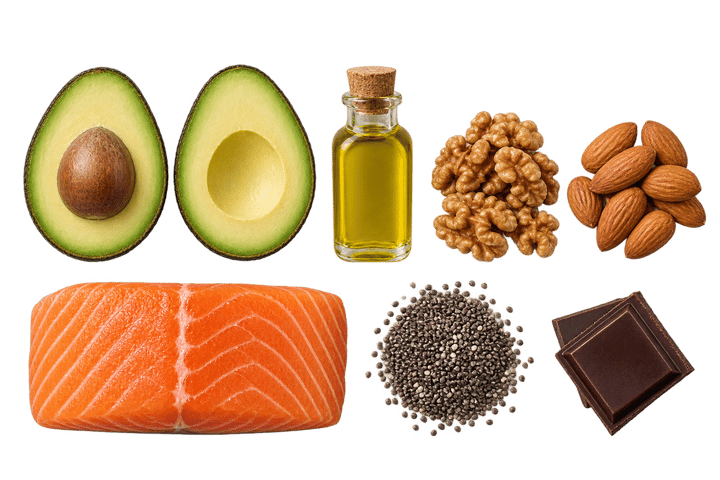
- Fat in whole foods. “Healthy fats are plentiful in many whole foods, such as meats, poultry, eggs, omega-3–rich seafood, nuts, seeds, full-fat dairy, olives, and avocados.”
- Full-fat dairy. “When consuming dairy, include full-fat dairy with no added sugars,” with a goal of 3 servings a day on 2,000 calories.
- Children. In the section on children 5 to 10, “Full-fat dairy products are important for children to help meet energy needs and support brain development.”
- Pregnancy. Pregnant women should eat “low-mercury omega-3–rich seafood (e.g., salmon, sardines, trout)”.
They set no range for total fat, and they don’t mention seed oils by name, for or against.
What changed from the 2020 guidelines
The 2020 to 2025 edition said to cook with “oils higher in polyunsaturated and monounsaturated fat (e.g., canola, corn, olive, peanut, safflower, soybean, and sunflower) rather than butter, shortening, or coconut or palm oils.”
The 2026 edition kept olive oil, dropped the list of seed oils, and moved butter and beef tallow from the “rather than” side to “other options”. It also moved dairy from low-fat toward full-fat. The 10% line didn’t move, and neither did the 20 g of saturated fat that food labels count as 100% of a day, which the FDA sets.
Butter and tallow in grams
A tablespoon of each, from the USDA’s tables, against the 22 g line on 2,000 calories:
| One tablespoon | Saturated fat | Share of a 22 g line |
|---|---|---|
| Ghee | 7.9 g | 36% |
| Butter | 7.2 g | 32% |
| Beef tallow | 6.4 g | 29% |
| Olive oil | 1.8 g | 8% |
| Canola oil | 1.0 g | 5% |
A tablespoon of butter or tallow in the pan each day is about a third of your line before you’ve eaten any cheese or meat. The oil compare puts any two of 13 fats side by side.
Full-fat dairy against the 10% line
The two dairy lines pull against each other. Three cups of whole milk, the daily dairy goal, hold 15.3 g of saturated fat, about 70% of a 2,000 calorie day’s line. The same three cups of 2% milk hold 8.7 g.
One portion, against a 22 g line
-
 A tablespoon of coconut oil 11.2 g 50%
-
 A tablespoon of butter 7.2 g 32%
-
 3 oz of 73% lean ground beef 6.9 g 31%
-
 A butter croissant 6.6 g 30%
-
 An ounce of cheddar 6.0 g 27%
-
 A cup of whole milk 5.1 g 23%
-
 A tablespoon of olive oil 1.8 g 8%
If your LDL is fine and the rest of your day is light on saturated fat, full-fat dairy fits. If cheese, butter and fatty meat already fill your day, the dairy goes on top. The full-fat dairy myth works through it, and is full-fat dairy healthy? has the short answer.
The year in fat, by date
- January 2026. The Dietary Guidelines for Americans, 2025 to 2030, come out, with the fat lines above.
- January 14, 2026. The Whole Milk for Healthy Kids Act is signed into law, so schools can serve whole and 2% milk again. Should kids drink whole milk? has what it means at home.
- March 13, 2026. The American College of Cardiology and the American Heart Association publish a new cholesterol guideline that brings back LDL goals, under 100 mg/dL for people at borderline or intermediate risk and under 70 for high risk. cholesterol.guide covers it.
- May 2026. JACC: Advances retracts the KETO-CTA paper, a 2025 study of people on keto with very high LDL that said their ApoB didn’t predict new plaque. The notice says the authors and editors asked for it over concerns about the study’s methods. Why is my LDL high on keto?
- May 8, 2026. The USDA’s final rule puts full-fat and 2% milk back into the federal child nutrition programs for everyone 2 and older.
What didn’t change
The FDA’s fish advice, at least 8 ounces of seafood a week, was last revised in October 2021 and still stands. The biggest review of the trials is still the Cochrane review from 2020, where eating less saturated fat cut heart attacks, strokes and other heart events by 17%.
We think the line that does the work in the 2026 guidelines is the one they kept, under 10% of calories from saturated fat. Cooking with olive oil, the fat they put first, is the easiest way to stay under it. Is butter back? goes through the butter question in full, and how much fat, and how much saturated fat? has the lines in grams.
12 sources
- US Department of Agriculture and US Department of Health and Human Services, Dietary Guidelines for Americans, 2025 to 2030, pp. 2, 3, 7 and 8, January 2026cdn.realfood.gov
- US Department of Agriculture and US Department of Health and Human Services, Dietary Guidelines for Americans, 2020 to 2025, p. 44, December 2020dietaryguidelines.gov
- Gebhardt and Thomas, Nutritive Value of Foods, Home and Garden Bulletin 72, Table 9, USDA Agricultural Research Service, 2002ars.usda.gov
- USDA SR Legacy, Fat, beef tallow (FDC 171400), via NutritionValue.orgnutritionvalue.org
- USDA SR Legacy, Butter oil, anhydrous (FDC 173412), via NutritionValue.orgnutritionvalue.org
- US Food and Drug Administration, Daily Value on the Nutrition and Supplement Facts Labelsfda.gov
- DTN Progressive Farmer, President Trump signs Whole Milk for Healthy Kids Act, January 16, 2026dtnpf.com
- US Department of Agriculture, USDA implements President Trump's Whole Milk for Healthy Kids Act, press release of May 8, 2026, as reprinted by Oklahoma Farm Reportoklahomafarmreport.com
- American College of Cardiology, ACC/AHA issue updated guideline for managing lipids, cholesterol, press release, March 13, 2026acc.org
- Retraction notice: Longitudinal data from the KETO-CTA study: plaque predicts plaque, ApoB does not, JACC: Advances, volume 5, issue 5, May 2026europepmc.org
- Hooper and others, Reduction in saturated fat intake for cardiovascular disease, Cochrane Database of Systematic Reviews, 2020pmc.ncbi.nlm.nih.gov
- US Food and Drug Administration, Advice about Eating Fish, advice revised October 2021fda.gov