The four fats, and why some are solid
On this page
Every fat in food is made of chains of carbon atoms. In saturated fat the chains are straight, so they pack tight and sit solid. In unsaturated fat each chain has one or more kinks, so the chains slide past each other and pour.
Most people think of a food as having one kind of fat. Butter is “saturated”, olive oil is “healthy”, and that’s the end of it. In fact every fat in your kitchen is a mix of all three kinds. Olive oil is about 13% saturated. Beef tallow, the fat people picture as the opposite of olive oil, is about 42% monounsaturated, the same kind of fat that fills a bottle of olive oil.
What we’d do
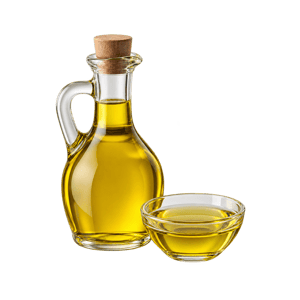
Use the counter test. Fats that sit solid at room temperature, such as butter, lard, tallow and coconut oil, are high in saturated fat, so count them. Fats that pour are mostly unsaturated, so make those your everyday cooking fat.
Coconut oil is the one people trip on. It comes from a plant, and it’s the most saturated cooking fat there is.
If you remember three things
- Saturated chains are straight and stack. That’s why butter, lard and coconut oil are solid on the counter.
- Monounsaturated fat has one kink and polyunsaturated has two or more. Olive oil is mostly mono, corn and sunflower oil mostly poly.
- Omega-3 and omega-6 are both polyunsaturated, and you need some of each. Your body can’t make them, so they’re called essential.
Why isn’t fat just one thing?
A fat molecule in food looks a bit like a capital E. The spine holds three long chains of carbon atoms, and the chains are what make one fat different from another. Each carbon in the chain can hold two hydrogen atoms. When every carbon holds as many as it can, the chain is called saturated, full of hydrogen.
Take two hydrogens away from neighboring carbons and the carbons form a double bond. In the fats in food, a double bond puts a kink in the chain. One kink makes a monounsaturated fat. Two or more make a polyunsaturated one.
Here’s one tablespoon of five fats, from the USDA’s tables. Each bar is the whole tablespoon, split into its kinds.
| Fat, 1 tablespoon | Saturated | Mono | Poly | The split |
|---|---|---|---|---|
| Coconut oil | 11.2 g | 0.9 g | 0.2 g | |
| Butter | 7.2 g | 3.3 g | 0.4 g | |
| Beef tallow | 6.4 g | 5.4 g | 0.5 g | |
| Olive oil | 1.8 g | 9.9 g | 1.1 g | |
| Sunflower oil | 1.4 g | 2.7 g | 8.9 g |
- Saturated
- Monounsaturated
- Polyunsaturated
- Trans
Butter’s tablespoon also carries about half a gram of trans fat, which happens naturally in milk fat. More on that in trans fat.
Why do straight chains sit solid?
Think of pencils in a box. Straight pencils lie flat against each other and fill the box tight. Now bend each one in the middle and toss them in. They can’t line up, so they jumble loosely and slide around.
Fat chains behave the same way. Straight saturated chains line up and cling to each other, so it takes more heat to pull them apart. Kinked chains can’t get as close, so they let go at a lower temperature.
The size of the effect is the surprise. Pure stearic acid, a saturated chain of 18 carbons, melts at about 157 °F (69 °C). Oleic acid has the same 18 carbons with one kink, and it melts at about 56 to 61 °F (13 to 16 °C). Linoleic acid, with two kinks, stays liquid down to about 20 °F (−7 °C). The atoms barely change, and the melting point drops by more than 130 °F.
 Saturated
 Monounsaturated
 Polyunsaturated
 Trans
You can watch a version of this in a fridge, slowly. In 2013 the UC Davis Olive Center put seven oils in a lab refrigerator at 40.5 °F (4.7 °C). After 60 hours nothing had changed. After five days, the three samples that were at least half virgin olive oil had started to set at the bottom of the bottle, which the team put down to the waxes and long chains in virgin olive oil. The mostly refined oils, canola and safflower among them, stayed liquid the whole time.
What are the four fats?
- Saturated. Straight chains. The US guidelines list the foods highest in it as fatty meat, whole milk, ice cream, cheese, butter, coconut oil, and palm and palm kernel oil.
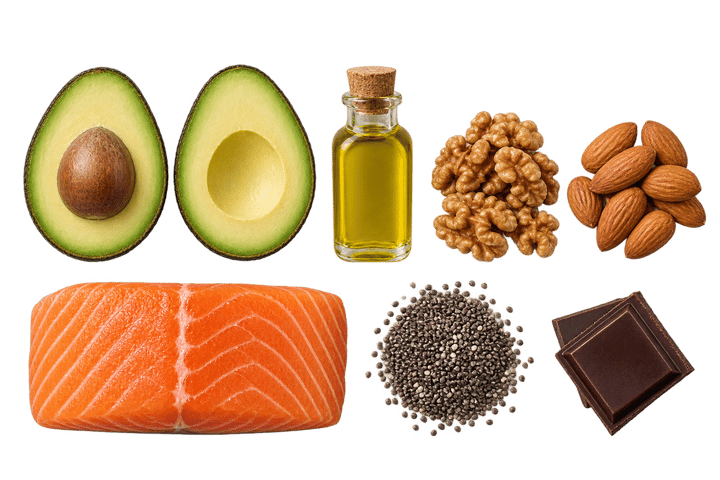
- Monounsaturated. One kink. Olive, canola and avocado oil, almonds and avocados are mostly this kind. So is close to half the fat in beef.
- Polyunsaturated. Two or more kinks. Corn and sunflower oil, walnuts, chia and flax are mostly this kind, and so are the omega-3 fats in fish. Omega-6 and omega-3 fats both live in this group.
- Trans. A kink twisted into the opposite shape, which lets the chain lie almost straight. Elaidic acid, the trans twin of oleic acid, melts at about 108 to 111 °F (42 to 44 °C), solid at room temperature like a saturated fat. Most of it came from partially hydrogenated oil, which the US has taken out of food.
The shape also changes what each fat does to your blood. Saturated fat slows how fast LDL cholesterol is cleared from the blood. Unsaturated fats add LDL receptors to your liver cells, the doors that pull LDL in. What saturated fat does has the trials.
Which fats can’t your body make?
Your body can make saturated and monounsaturated fat from other food. It can’t make two polyunsaturated fats: linoleic acid, an omega-6, and alpha-linolenic acid (ALA), an omega-3. These are the essential fatty acids.
The US guidelines set an Adequate Intake for each. For linoleic acid it’s 12 g a day for women 19 to 50 and 11 g at 51 and older, and 17 g for men 19 to 50 and 14 g at 51 and older. For ALA it’s 1.1 g for women and 1.6 g for men.
A tablespoon of corn oil has about 7.5 g of linoleic acid. A tablespoon of canola oil has about 1.3 g of ALA, and a tablespoon of ground flaxseed about 1.6 g.
There’s an odd fact in the 2026 guidelines here. They tell you to “prioritize oils with essential fatty acids, such as olive oil”. Olive oil is mostly monounsaturated, with about 1.4 g of linoleic acid a tablespoon. The seed oils the guidelines don’t name carry several times more of the essential fats.
What do the omega numbers mean?
Count the carbons from the tail end of the chain. In an omega-3 fat the first kink comes after the third carbon, and in an omega-6 after the sixth. That small change in position gives them different jobs in the body.
The omega-3s in the heart and brain studies are EPA and DHA, long chains found mostly in fish. They start in algae, and fish build them up by eating algae or smaller fish, which is why algae oil works for people who don’t eat fish. Omega-3 and omega-6 covers how much you need.
More detail: the chemistry in a few lines
A food fat is mostly triglycerides: glycerol with three fatty acids attached. Fatty acids are named by their carbon count and double bonds. Stearic acid is 18:0, oleic 18:1, linoleic 18:2 and alpha-linolenic 18:3. In nature nearly all double bonds are in the cis shape, which bends the chain. A trans double bond keeps the chain close to straight.
The melting points here are for the pure fatty acids, from the CRC Handbook of Chemistry and Physics as listed on PubChem. Real fats are mixes of many triglycerides, so they soften over a range of temperatures instead of melting at one point.
13 sources
- PubChem, Stearic acid (CID 5281), melting point from the CRC Handbook of Chemistry and Physicspubchem.ncbi.nlm.nih.gov
- PubChem, Oleic acid (CID 445639), melting pointpubchem.ncbi.nlm.nih.gov
- PubChem, Linoleic acid (CID 5280450), melting pointpubchem.ncbi.nlm.nih.gov
- PubChem, Elaidic acid (CID 637517), melting pointpubchem.ncbi.nlm.nih.gov
- Gebhardt and Thomas, Nutritive Value of Foods, Home and Garden Bulletin 72, Table 9, USDA Agricultural Research Service, 2002ars.usda.gov
- USDA FoodData Central SR Legacy, Oil, coconut (FDC 171412), as listed on NutritionValue.orgnutritionvalue.org
- USDA FoodData Central SR Legacy, Fat, beef tallow (FDC 171400), as listed on NutritionValue.orgnutritionvalue.org
- USDA FoodData Central SR Legacy, Butter, salted (FDC 173410), total trans fatty acidsfdc.nal.usda.gov
- Li, Wang and Flynn, Refrigeration is not reliable in detecting olive oil adulteration, UC Davis Olive Center, March 2013olivecenter.ucdavis.edu
- US Department of Agriculture and US Department of Health and Human Services, Dietary Guidelines for Americans, 2020 to 2025, p. 44 and Appendix 1 Table A1-2, December 2020dietaryguidelines.gov
- US Department of Agriculture and US Department of Health and Human Services, Dietary Guidelines for Americans, 2025 to 2030, p. 3, January 2026cdn.realfood.gov
- Fernandez and West, Mechanisms by which dietary fatty acids modulate plasma lipids, Journal of Nutrition, 2005pubmed.ncbi.nlm.nih.gov
- Doughman, Krupanidhi and Sanjeevi, Omega-3 fatty acids for nutrition and medicine: considering microalgae oil as a vegetarian source of EPA and DHA, Current Diabetes Reviews, 2007pubmed.ncbi.nlm.nih.gov