How much omega-3 do I need a day?
On this page
The US advice counts fish rather than milligrams: at least 8 ounces of seafood a week. If those 8 ounces are salmon, sardines or trout, that comes to about 280 to 700 mg of EPA and DHA a day. The counter below adds up your own week.
Fish oil bottles talk in milligrams, so people go looking for a milligram target. The FDA’s advice is about plates of fish, and the fish you pick changes the omega-3 a lot. Eight ounces of salmon a week gives about ten times the EPA and DHA of 8 ounces of canned light tuna.
What we’d do: eat fish twice a week, a 4 oz serving each time, and make at least one of them salmon, sardines, herring or mackerel. Do that before you buy a capsule.
What 8 ounces a week gives you
| Fish (USDA) | EPA plus DHA in 3 oz | A day, from 8 oz a week |
|---|---|---|
| Salmon, Atlantic, farmed | 1.83 g | about 700 mg |
| Sardines, canned | 0.83 g | about 320 mg |
| Trout, rainbow, farmed | 0.74 g | about 280 mg |
| Light tuna, canned | 0.19 g | about 70 mg |
The math is the grams in 3 oz × 8 ÷ 3 for the week, then ÷ 7 for the day. EPA and DHA are the two omega-3s in fish, and they’re what fish oil capsules and the big heart trials measure.
Plant omega-3 is a separate number
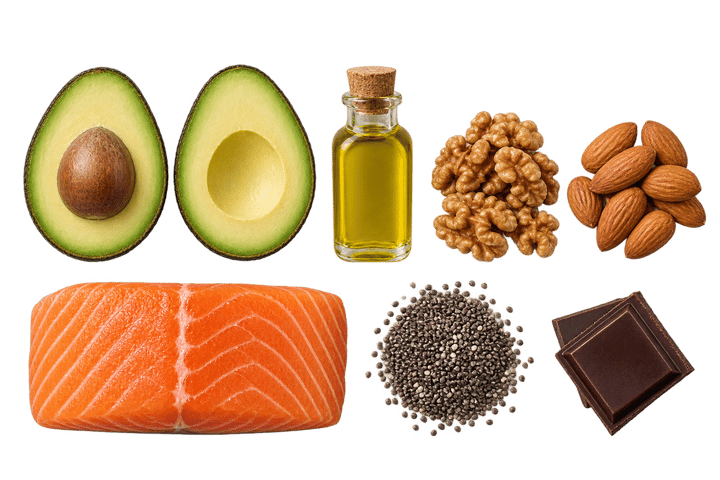
There’s a third omega-3, alpha-linolenic acid (ALA), in flaxseed, chia, walnuts and canola oil. The US sets a floor for it, the Adequate Intake, at 1.1 g a day for women and 1.6 g for men. It’s an essential fat, and it’s easy to get.
It doesn’t stand in for fish. Your body turns only a small part of ALA into EPA and DHA. When researchers gave young women a measured dose of tagged ALA, about 21% of it ended up as EPA and 9% as DHA, and men convert less. The counter keeps ALA on its own line and never adds it to EPA and DHA.
If you’re pregnant or breastfeeding
The FDA’s advice goes up to 8 to 12 ounces a week, two to three 4 oz servings from its lower-mercury Best Choices list, which includes salmon, sardines, trout, herring and canned light tuna. Skip the highest-mercury fish: king mackerel, marlin, orange roughy, shark, swordfish, tilefish from the Gulf of Mexico and bigeye tuna.
Why fish before capsules
In VITAL, 25,871 US adults took 1 g of fish oil or a placebo every day for about five years. Major heart events came out at 386 against 419, which wasn’t a real difference. Fish oil capsules protect your heart has the rest of that trial, and how many fish oil capsules covers the label if you take them anyway.
Fish in a usual week
 Salmon1828 mg EPA plus DHA in 3 oz4 oz
 Sardines835 mg EPA plus DHA in 3 oz0 oz
- Trout744 mg EPA plus DHA in 3 oz0 oz
 Tuna, canned light190 mg EPA plus DHA in 3 oz3 oz
7 oz a week. The US advice is at least 8 oz, two servings of 4 oz.
A fish oil capsule, from the back of the bottle
375 mgof EPA plus DHA a day
You're in or above the band the US fish advice gives. Fish does this without a capsule.
Plant omega-3 (ALA), on its own line
 Walnuts1 oz (14 halves): 2.5 g ALA0 a week
 Ground flaxseed1 tbsp: 1.6 g ALA0 a week
 Chia seeds1 oz: 5.1 g ALA0 a week
- Canola oil1 tbsp: 1.3 g ALA0 a week
0 g of ALA a day from these, against the Adequate Intake of 1.1 g. Oils, nuts and other foods add more.
Your body turns only a small part of ALA into EPA and DHA. In one tracer study of young women it was about 21% to EPA and 9% to DHA, and less in men. So the two are never added together here.
9 sources
- US Food and Drug Administration, Advice about Eating Fish, current as of March 5, 2024fda.gov
- USDA SR Legacy, Fish, salmon, Atlantic, farmed, cooked (FDC 175168), via NutritionValue.orgnutritionvalue.org
- USDA SR Legacy, Fish, sardine, Atlantic, canned in oil (FDC 175139), via NutritionValue.orgnutritionvalue.org
- USDA SR Legacy, Fish, rainbow trout, farmed, cooked (FDC 173718), via NutritionValue.orgnutritionvalue.org
- USDA SR Legacy, Fish, light tuna, canned in water (FDC 173709), via NutritionValue.orgnutritionvalue.org
- US Department of Agriculture and US Department of Health and Human Services, Dietary Guidelines for Americans, 2020 to 2025, Appendix 1, Table A1-2, 2020dietaryguidelines.gov
- Burdge and Wootton, Conversion of alpha-linolenic acid to eicosapentaenoic, docosapentaenoic and docosahexaenoic acids in young women, British Journal of Nutrition, 2002europepmc.org
- Burdge and Calder, Conversion of alpha-linolenic acid to longer-chain polyunsaturated fatty acids in human adults, Reproduction Nutrition Development, 2005europepmc.org
- Manson et al., Marine n-3 fatty acids and prevention of cardiovascular disease and cancer (VITAL), New England Journal of Medicine, 2019pmc.ncbi.nlm.nih.gov