What's the easiest way to cut saturated fat?
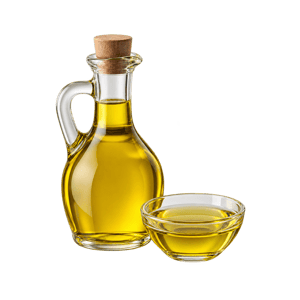
Change the fat in your pan. If you cook with a tablespoon of butter a day, olive oil in its place takes off 5.4 g of saturated fat and canola oil 6.2 g. That’s about a quarter of a 2,000 calorie day’s line, and it takes one bottle.
Cutting saturated fat sounds like giving up foods you love, one at a time. The cooking fat is different. You change it once at the store, and it repeats every day without you thinking about it. The eggs, the vegetables and the dinner stay the same.
What we’d do: swap the cooking fat first, then check the scorer below for the next biggest source in your day.
A day, before and after
Here’s an ordinary day from the USDA tables: two eggs cooked in a tablespoon of butter, a sandwich with an ounce of cheddar, a 3 oz burger of 83% lean beef and a cup of whole milk.
| Saturated fat | |
|---|---|
| Eggs (3.2 g), butter (7.2 g), cheddar (6.0 g), burger (5.5 g), milk (5.1 g) | 27.0 g |
| The same day with the eggs cooked in olive oil (1.8 g) | 21.6 g |
The first day is over the 22 g line for 2,000 calories. The second is under it, and the only thing that changed was the pan.
The swaps, by grams saved
| Swap (USDA) | Saved |
|---|---|
| Canola or olive oil in place of a tablespoon of coconut oil | 9.4 to 10.2 g |
| Whole wheat toast (2 slices) in place of a butter croissant | 6.0 g |
| One ounce of cheddar a day in place of two | 6.0 g |
| Half a chicken breast (3 oz) in place of a 3 oz burger of 73% lean beef | 6.0 g |
| Canola or olive oil in place of a tablespoon of butter | 5.4 to 6.2 g |
| Olive oil in place of two teaspoons of butter on toast | 3.8 g |
| 2% milk in place of whole, 1 cup | 2.2 g |
The pan wins on ease rather than grams, since it’s one change that repeats. A croissant swap saves more, but only on the days you’d have had one.
The evidence for the oil swap
The swap from butter to plant oil also has direct evidence behind it. In 221,054 US adults followed for up to 33 years, replacing 10 g of butter a day with plant oils went with 17% fewer deaths, and 17% fewer cancer deaths. Ten grams is about two thirds of a tablespoon, a little less than the spoonful in the pan above. That study followed people rather than assigning diets, so it can’t prove cause, but it fits what the trials found for saturated fat.
The 2020 to 2025 US guidelines give the same advice, to cook with oils such as canola, corn, olive, peanut, safflower, soybean and sunflower in place of butter. Swapping saturated fat for vegetable oils lowers LDL, and cholesterol.guide works out how much for your number. The quiz finds the swap for a usual week of yours in about two minutes.
5 sources
- Gebhardt and Thomas, Nutritive Value of Foods, Home and Garden Bulletin 72, Table 9, USDA Agricultural Research Service, 2002ars.usda.gov
- USDA SR Legacy, Oil, coconut (FDC 171412), via NutritionValue.orgnutritionvalue.org
- Zhang et al., Butter and plant-based oils intake and mortality, JAMA Internal Medicine, 2025pmc.ncbi.nlm.nih.gov
- Fernandez and West, Mechanisms by which dietary fatty acids modulate plasma lipids, Journal of Nutrition, 2005europepmc.org
- US Department of Agriculture and US Department of Health and Human Services, Dietary Guidelines for Americans, 2020 to 2025, pp. 44 and 102, 2020dietaryguidelines.gov