What are healthy fats?
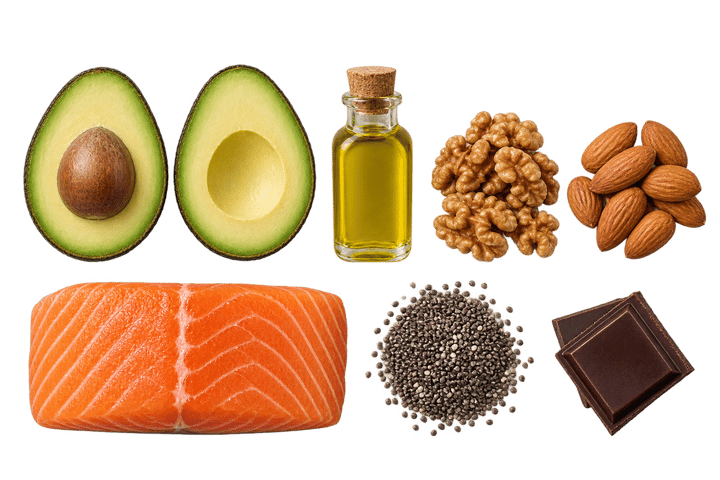
Mostly the unsaturated fats: olive oil, canola and other plant oils, nuts, seeds, avocado, and oily fish like salmon and sardines. Eaten in place of butter, cheese and fatty meat, they lower LDL, and two of them are fats your body can’t make at all.
“Healthy fat” has come to mean almost anything. The 2026 US guidelines say healthy fats are “plentiful in many whole foods, such as meats, poultry, eggs, omega-3–rich seafood, nuts, seeds, full-fat dairy, olives, and avocados,” and list butter and beef tallow as cooking options after olive oil. In the same paragraph, they keep saturated fat under 10% of your calories, which butter, tallow and full-fat dairy fill fast.
We use a narrower test. A healthy fat is one that lowers LDL when it takes the place of saturated fat, or one your body needs and can’t make. That points to the same short list every time.
The two good kinds
Monounsaturated fat has one bend in each chain. It’s most of the fat in olive oil, canola oil, avocado and almonds.
Polyunsaturated fat has several bends. It’s most of the fat in corn oil, sunflower oil and walnuts, and it includes the two essential fats, linoleic acid (an omega-6) and alpha-linolenic acid (a plant omega-3). The fish omega-3s, EPA and DHA, are polyunsaturated too.
| Food (USDA) | Saturated | Mono | Poly |
|---|---|---|---|
| Olive oil, 1 tbsp | 1.8 g | 9.9 g | 1.1 g |
| Canola oil, 1 tbsp | 1.0 g | 8.2 g | 4.1 g |
| Almonds, 1 oz | 1.1 g | 9.1 g | 3.5 g |
| Walnuts, 1 oz | 1.7 g | 2.5 g | 13.4 g |
| Avocado, 1 oz | 0.7 g | 3.2 g | 0.6 g |
| Butter, 1 tbsp | 7.2 g | 3.3 g | 0.4 g |
Butter is there for scale. A spoon of it has four times the saturated fat of olive oil.
What the evidence says
The 2020 to 2025 US guidelines named the oils to cook with in place of butter, shortening, coconut or palm oil: canola, corn, olive, peanut, safflower, soybean and sunflower.
In 221,054 US adults followed for up to 33 years, people who ate the most plant oil had 16% fewer deaths than those who ate the least. Each extra 5 g a day of canola oil went with 15% fewer deaths, olive oil 8% and soybean oil 6%. That’s observational, so other habits may explain part of it.
The omega-6 in seed oils gets blamed for inflammation, so the blood tests are the interesting part. Across 30 studies in 13 countries with 68,659 people, those with more linoleic acid in their blood had fewer heart events and 22% fewer cardiovascular deaths. Are seed oils bad for you? covers the rest of that argument.
What we’d do
Make extra virgin olive oil your everyday fat, keep canola for baking and neutral jobs, eat a handful of nuts most days, and have salmon, sardines or trout twice a week. Keep butter for where you taste it. Salmon brings its own omega-3, about 1.8 g of EPA and DHA in 3 oz, which the omega-3 counter adds up for your week.
- Saturated
- Monounsaturated
- Polyunsaturated
Coconut oil
11.2 g saturated a tablespoon
- Mono
- 0.9 g
- Poly
- 0.2 g
- Saturated share
- 83%
Smoked at 376 °F (191 °C) in one 2018 lab test of supermarket bottles.
The most saturated cooking fat, about 83%. Use it for flavor, not as your everyday oil.
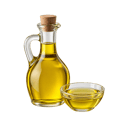
Olive oil
1.8 g saturated a tablespoon
- Mono
- 9.9 g
- Poly
- 1.1 g
- Saturated share
- 13%
Smoked at 404 °F (207 °C) in one 2018 lab test of supermarket bottles (extra virgin 404 °F, olive 406 °F, virgin 348 °F).
Everyday cooking, roasting and dressing. In the test, extra virgin olive oil made the fewest breakdown compounds averaged over both heating runs, with coconut oil close behind.
The heat test
Deep frying usually tops out at 356 °F (180 °C). Averaged over both heating runs, extra virgin olive oil made the fewest breakdown compounds of the ten bottles, with coconut oil close behind, and canola the most. Smoke point didn't predict that. The lab was an olive oil company's (de Alzaa 2018), and the test bottles were Australian.
These are the US guideline's lines. The Gyroscope app personalizes yours.
7 sources
- US Department of Agriculture and US Department of Health and Human Services, Dietary Guidelines for Americans, 2025 to 2030, p. 3, January 2026cdn.realfood.gov
- US Department of Agriculture and US Department of Health and Human Services, Dietary Guidelines for Americans, 2020 to 2025, p. 44, 2020dietaryguidelines.gov
- Zhang et al., Butter and plant-based oils intake and mortality, JAMA Internal Medicine, 2025pmc.ncbi.nlm.nih.gov
- Marklund et al., Biomarkers of dietary omega-6 fatty acids and incident cardiovascular disease and mortality (FORCE), Circulation, 2019europepmc.org
- Clark et al., Biology 2e, section 3.3 Lipids, OpenStax, Rice University, 2018openstax.org
- Gebhardt and Thomas, Nutritive Value of Foods, Home and Garden Bulletin 72, Table 9, USDA Agricultural Research Service, 2002ars.usda.gov
- USDA SR Legacy, Fish, salmon, Atlantic, farmed, cooked (FDC 175168), via NutritionValue.orgnutritionvalue.org