What is saturated fat?
Saturated fat is fat whose chains are straight, so they stack tightly and stay solid at room temperature. Butter, cheese, fatty meat, coconut oil and palm oil have the most. It’s the kind of fat that raises LDL, which is why the US guidelines cap it at 10% of your calories.
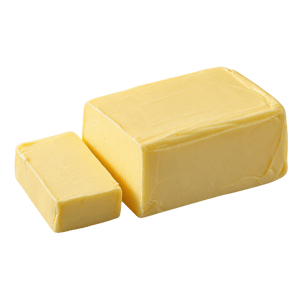
Put a stick of butter and a bottle of olive oil on the same counter. One holds its shape and the other pours. That difference comes down to the shape of the fat inside, and the same shape is the start of why the two do different things in your blood.
How the shape works
Most of the fat you eat is made of fatty acids, long chains of carbon atoms. In a saturated fatty acid, every link in the chain is a single bond, so the chain runs straight. Straight chains pack tightly against each other, like pencils in a box, and that’s why saturated fats are solid at room temperature.
In an unsaturated fatty acid, there’s at least one double bond, and in the cis form it puts a bend in the chain. Bent chains can’t line up, like a pile of bent paper clips, so the fat stays liquid. One bend makes a monounsaturated fat, as in olive oil. Several make a polyunsaturated fat, as in corn oil and walnuts.
No food is all one kind
Every fat is a mix, and the label’s saturated fat line tells you how much of it is the straight kind.
| Fat, 1 tbsp (USDA) | Saturated | Monounsaturated | Polyunsaturated |
|---|---|---|---|
| Coconut oil | 11.2 g | 0.9 g | 0.2 g |
| Butter | 7.2 g | 3.3 g | 0.4 g |
| Lard | 5.0 g | 5.8 g | 1.4 g |
| Olive oil | 1.8 g | 9.9 g | 1.1 g |
| Canola oil | 1.0 g | 8.2 g | 4.1 g |
About 83% of coconut oil’s fat is saturated, against about 62% of butter’s, which surprises most people. Coconut oil is a plant fat, and it’s more saturated than butter or beef tallow. Olive oil is about 13% saturated and canola about 7%.
The 2020 to 2025 US guidelines list the foods with the most: high-fat meat, full-fat dairy such as whole milk, ice cream and cheese, butter, coconut oil, and palm and palm kernel oil.
Not all saturated fats act the same
Saturated fatty acids come in different lengths. In a set of hamster experiments published in 1992, the 12, 14 and 16 carbon chains turned down the liver’s LDL receptors and about doubled LDL. The 18 carbon one, stearic acid, and the short ones from 6 to 10 carbons didn’t. Food labels add them all up into one saturated fat number, so the 10% line counts them together. Why saturated fat raises cholesterol has more of that story, and the four fats covers trans fat and omega-3.
The label’s Daily Value for saturated fat is 20 g, but your own line depends on your calories. How much saturated fat a day works it out, and the tool below shows a tablespoon of any of 13 cooking fats against it.
- Saturated
- Monounsaturated
- Polyunsaturated
Coconut oil
11.2 g saturated a tablespoon
- Mono
- 0.9 g
- Poly
- 0.2 g
- Saturated share
- 83%
Smoked at 376 °F (191 °C) in one 2018 lab test of supermarket bottles.
The most saturated cooking fat, about 83%. Use it for flavor, not as your everyday oil.
Olive oil
1.8 g saturated a tablespoon
- Mono
- 9.9 g
- Poly
- 1.1 g
- Saturated share
- 13%
Smoked at 404 °F (207 °C) in one 2018 lab test of supermarket bottles (extra virgin 404 °F, olive 406 °F, virgin 348 °F).
Everyday cooking, roasting and dressing. In the test, extra virgin olive oil made the fewest breakdown compounds averaged over both heating runs, with coconut oil close behind.
The heat test
Deep frying usually tops out at 356 °F (180 °C). Averaged over both heating runs, extra virgin olive oil made the fewest breakdown compounds of the ten bottles, with coconut oil close behind, and canola the most. Smoke point didn't predict that. The lab was an olive oil company's (de Alzaa 2018), and the test bottles were Australian.
These are the US guideline's lines. The Gyroscope app personalizes yours.
6 sources
- Clark et al., Biology 2e, section 3.3 Lipids, OpenStax, Rice University, 2018openstax.org
- US Department of Agriculture and US Department of Health and Human Services, Dietary Guidelines for Americans, 2020 to 2025, p. 44, 2020dietaryguidelines.gov
- Gebhardt and Thomas, Nutritive Value of Foods, Home and Garden Bulletin 72, Table 9, USDA Agricultural Research Service, 2002ars.usda.gov
- USDA SR Legacy, Oil, coconut (FDC 171412), via NutritionValue.orgnutritionvalue.org
- Woollett, Spady and Dietschy, Regulatory effects of the saturated fatty acids 6:0 through 18:0 on hepatic low density lipoprotein receptor activity in the hamster, Journal of Clinical Investigation, 1992europepmc.org
- US Food and Drug Administration, Daily Value on the Nutrition and Supplement Facts Labelsfda.gov