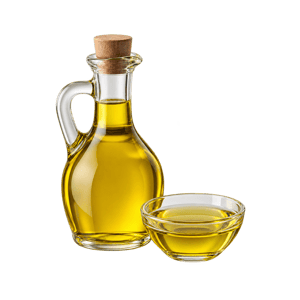
What is the smoke point of olive oil?
On this page
In the one lab test that measured it beside other supermarket oils, extra virgin olive oil started smoking at 404 °F (207 °C). Refined olive oil smoked at 406 °F (208 °C) and virgin olive oil at 348 °F (175 °C). Deep frying tops out around 356 °F (180 °C), so extra virgin olive oil has room to spare.
You’ve probably heard you shouldn’t cook with olive oil because its smoke point is low. The idea is that an oil starts breaking down when it smokes, so a higher smoke point means a safer oil. The same test found the opposite. The oils with the highest smoke points made the most breakdown compounds when they were heated for hours.
What we’d do: cook with extra virgin olive oil, frying included. If the pan smokes, turn the heat down. Don’t keep frying oil going for days, whatever the oil.
What a smoke point is
Smoke point is the temperature where an oil gives off a steady bluish smoke. The fat is breaking apart into glycerol and free fatty acids, and the glycerol breaks down further into acrolein, a big part of that smoke. How early it happens depends mostly on how much free fatty acid is in the oil to begin with, so it varies with how the oil was made and how much it was refined. Every oil’s smoke point also drops as it’s heated, and the longer it’s used the lower it goes.
The test
In 2018, researchers at Modern Olives Laboratory Services in Australia, a lab that belongs to an olive oil company, bought ten common cooking oils at the supermarket. They heated each one slowly from room temperature up to 464 °F, and in a second trial held about 3 quarts (3 liters) of each at 356 °F in a deep fryer for 6 hours, sampling as they went.
| Oil | Smoke point | Polar compounds at the end, both trials averaged |
|---|---|---|
| Canola | 492 °F | 22.4% |
| Sunflower | 490 °F | 15.6% |
| High oleic peanut | 439 °F | 10.7% |
| Refined olive oil | 406 °F | 11.7% |
| Extra virgin olive oil | 404 °F | 8.5% |
| Avocado | 386 °F | 11.6% |
| Coconut | 376 °F | 9.3% |
| Virgin olive oil | 348 °F | 10.7% |
Polar compounds are the damaged fat that builds up as oil cooks, and many countries set a legal limit for them in frying oil. Averaged over the two heat tests, extra virgin olive oil made the fewest, with coconut oil close behind, and canola made the most. The authors found that a higher smoke point went with more polar compounds, and concluded that “smoke point does not predict oil performance when heated.” They credit extra virgin olive oil’s fatty acid profile and its natural antioxidants.
The limits
It’s one study, from a lab with an interest in olive oil, and the authors point out that no food was cooked. Water and steam from real food change what happens in the pan. The bottles were Australian supermarket oils, and two bottles with the same name can smoke at different temperatures. The olive oil myth has the rest, and oil compare shows the measured smoke point for each oil that was tested.
- Saturated
- Monounsaturated
- Polyunsaturated
Coconut oil
11.2 g saturated a tablespoon
- Mono
- 0.9 g
- Poly
- 0.2 g
- Saturated share
- 83%
Smoked at 376 °F (191 °C) in one 2018 lab test of supermarket bottles.
The most saturated cooking fat, about 83%. Use it for flavor, not as your everyday oil.
Olive oil
1.8 g saturated a tablespoon
- Mono
- 9.9 g
- Poly
- 1.1 g
- Saturated share
- 13%
Smoked at 404 °F (207 °C) in one 2018 lab test of supermarket bottles (extra virgin 404 °F, olive 406 °F, virgin 348 °F).
Everyday cooking, roasting and dressing. In the test, extra virgin olive oil made the fewest breakdown compounds averaged over both heating runs, with coconut oil close behind.
The heat test
Deep frying usually tops out at 356 °F (180 °C). Averaged over both heating runs, extra virgin olive oil made the fewest breakdown compounds of the ten bottles, with coconut oil close behind, and canola the most. Smoke point didn't predict that. The lab was an olive oil company's (de Alzaa 2018), and the test bottles were Australian.
These are the US guideline's lines. The Gyroscope app personalizes yours.
1 sources
- de Alzaa, Guillaume and Ravetti, Evaluation of Chemical and Physical Changes in Different Commercial Oils during Heating, Acta Scientific Nutritional Health, 2018 (Modern Olives Laboratory Services, Australia)actascientific.com