Is coconut oil healthy?
Not as an everyday oil. Coconut oil is about 83% saturated fat, more than butter at about 62%, so a tablespoon holds 11.2 g, half of a 2,000 calorie day’s line. In 16 trials it raised LDL by about 10 mg/dL compared with non-tropical plant oils. Use it for flavor and cook with olive or canola the rest of the time.
Coconut oil’s good name rests on being a plant fat and on its “medium-chain” fats, which sound like a different thing from the fat in butter. The trials don’t bear that out. On LDL it acts like a saturated fat, because that’s mostly what it is.
What we’d do: keep a jar for the dishes where you want the taste, a curry or a batch of granola, and count it when you do. A teaspoon is about 3.7 g of saturated fat, a tablespoon 11.2 g. For everyday cooking, olive oil or canola does the same job with a sixth of the saturated fat or less.
What’s in a tablespoon
| Coconut oil, 1 tbsp (USDA) | Grams |
|---|---|
| Saturated fat | 11.2 g |
| of which the 12 carbon kind (lauric acid) | 5.7 g |
| of which the 14 carbon kind (myristic acid) | 2.3 g |
| of which the 16 carbon kind (palmitic acid) | 1.2 g |
| of which the 8 and 10 carbon kinds | 1.7 g |
| Monounsaturated fat | 0.9 g |
| Polyunsaturated fat | 0.2 g |
The “medium-chain” argument rests on the 8 and 10 carbon fats, and they’re only 1.7 g of the 11.2. Most of the rest is the 12, 14 and 16 carbon kinds. In hamster experiments in 1992, those three were exactly the saturated fats that turned down the liver’s LDL receptors and about doubled LDL, while the 8 and 10 carbon ones didn’t.
What the trials found
A 2020 review in Circulation pooled 16 trials, each at least two weeks long, that compared coconut oil with other fats.
- Against non-tropical plant oils, coconut oil raised LDL by about 10 mg/dL.
- It raised HDL too, by about 4 mg/dL.
- No effect showed up on blood sugar, inflammation, body weight or bodyfat.
Coconut oil’s fans point to the HDL rise. Whether that helps your heart is a separate argument that cholesterol.guide covers, and the LDL rise is the part with the clearer meaning.
In the pan
Coconut oil does hold up well in heat. In a 2018 lab test of ten supermarket oils, it smoked at 376 °F and, averaged over two heating runs, made the second fewest breakdown compounds after extra virgin olive oil, because saturated fat resists breaking down. That makes it stable in a fryer, and it doesn’t change what it does to your LDL.
The 2020 to 2025 US guidelines say to cook with oils such as canola, corn and olive rather than butter, shortening, or coconut or palm oil. Oil compare shows a spoon of it next to any other fat.
- Saturated
- Monounsaturated
- Polyunsaturated
Coconut oil
11.2 g saturated a tablespoon
- Mono
- 0.9 g
- Poly
- 0.2 g
- Saturated share
- 83%
Smoked at 376 °F (191 °C) in one 2018 lab test of supermarket bottles.
The most saturated cooking fat, about 83%. Use it for flavor, not as your everyday oil.
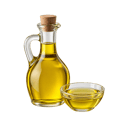
Olive oil
1.8 g saturated a tablespoon
- Mono
- 9.9 g
- Poly
- 1.1 g
- Saturated share
- 13%
Smoked at 404 °F (207 °C) in one 2018 lab test of supermarket bottles (extra virgin 404 °F, olive 406 °F, virgin 348 °F).
Everyday cooking, roasting and dressing. In the test, extra virgin olive oil made the fewest breakdown compounds averaged over both heating runs, with coconut oil close behind.
The heat test
Deep frying usually tops out at 356 °F (180 °C). Averaged over both heating runs, extra virgin olive oil made the fewest breakdown compounds of the ten bottles, with coconut oil close behind, and canola the most. Smoke point didn't predict that. The lab was an olive oil company's (de Alzaa 2018), and the test bottles were Australian.
These are the US guideline's lines. The Gyroscope app personalizes yours.
6 sources
- USDA SR Legacy, Oil, coconut (FDC 171412), via NutritionValue.orgnutritionvalue.org
- Gebhardt and Thomas, Nutritive Value of Foods, Home and Garden Bulletin 72, Table 9, USDA Agricultural Research Service, 2002ars.usda.gov
- Neelakantan, Seah and van Dam, The effect of coconut oil consumption on cardiovascular risk factors, Circulation, 2020europepmc.org
- Woollett, Spady and Dietschy, Regulatory effects of the saturated fatty acids 6:0 through 18:0 on hepatic low density lipoprotein receptor activity in the hamster, Journal of Clinical Investigation, 1992europepmc.org
- de Alzaa, Guillaume and Ravetti, Evaluation of Chemical and Physical Changes in Different Commercial Oils during Heating, Acta Scientific Nutritional Health, 2018 (Modern Olives Laboratory Services, Australia)actascientific.com
- US Department of Agriculture and US Department of Health and Human Services, Dietary Guidelines for Americans, 2020 to 2025, p. 44, 2020dietaryguidelines.gov