How much fat should I eat a day?
Between 20 and 35% of your calories. On 2,000 calories that’s about 44 to 78 g of fat a day. Inside that, keep saturated fat under 10%, about 22 g. The tool below works out both for your calories.
The range is wide on purpose. A day built on olive oil, nuts and fish can sit at the top of it, and a day of grains, beans and lean meat can sit near the bottom, and both can be healthy. What changes your blood is the kind of fat, so that’s where we’d spend the attention.
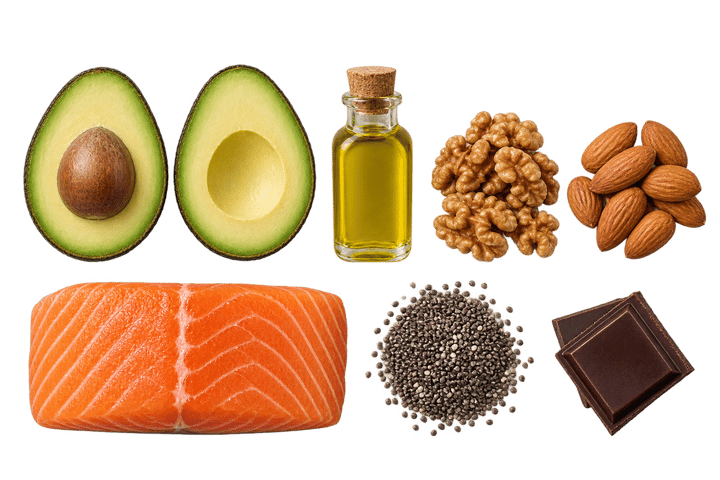
What we’d do: stop counting total fat and pick the kind. Olive or canola oil, nuts, seeds, avocado and fish go up, and butter, cheese and fatty meat come down until saturated fat is under your line.
The band at common calorie levels
| Calories a day | Total fat (20 to 35%) | Saturated fat (under 10%) |
|---|---|---|
| 1,200 | 27 to 47 g | 13 g |
| 1,500 | 33 to 58 g | 17 g |
| 1,800 | 40 to 70 g | 20 g |
| 2,000 | 44 to 78 g | 22 g |
| 2,500 | 56 to 97 g | 28 g |
| 3,000 | 67 to 117 g | 33 g |
The math is calories × 0.20 ÷ 9 for the bottom and × 0.35 ÷ 9 for the top, since fat has 9 calories a gram. These are the US guideline’s lines. The Gyroscope app personalizes yours.
The label’s Daily Value for fat is 78 g, the same for everyone. On 2,000 calories that’s exactly the top of the band, so eating the label’s whole 78 g puts you at the ceiling.
Low fat or high fat for weight
For weight, they come out about even. In DIETFITS, 609 adults ate either a healthy low-fat diet or a healthy low-carb diet for a year. The low-fat group ended up eating 29% of their calories as fat and the low-carb group 45%. They lost about the same weight, about 12 and 13 pounds (5.3 and 6.0 kg), and the gap was too small to count. Fat has 9 calories a gram, so portions decide the weight. bodyfat.guide has the rest of that argument.
The floor
There are two fats your body can’t make, so you have to eat them, and both are polyunsaturated. The US Adequate Intakes are about 12 g a day of linoleic acid (omega-6) for women and 17 g for men up to age 50, and 1.1 g a day of alpha-linolenic acid (plant omega-3) for women and 1.6 g for men.
A tablespoon of corn oil has 8.0 g of polyunsaturated fat. A tablespoon of canola oil has 2.6 g of linoleic acid and 1.3 g of alpha-linolenic acid, more than a woman’s whole day of the second one. A very low fat day built without oils, nuts or seeds can come up short on both.
Not sure? tdee.guide works out yours from your steps. Food labels use 2,000.
44to78grams of fat a day, 20 to 35% of 2,000 calories
Inside it, saturated fat under 22.2 g. The kind matters more than the total.
The band is wide on purpose. Both of those days sit in it. In a 609-person, 12-month trial, a healthy low-fat and a healthy low-carb diet lost about the same weight: 5.3 kg against 6.0 kg (DIETFITS, Gardner 2018).
The floor: fats your body can't make
- Linoleic acid (omega-6)
- 12 g a day
- Alpha-linolenic acid (omega-3)
- 1.1 g a day
- A tablespoon of corn oil has 8 g of polyunsaturated fat, most of it linoleic acid (7.5 g).
- An ounce of walnuts has 2.5 g of alpha-linolenic acid, and 10.7 g of linoleic acid.
- A tablespoon of ground flaxseed has 1.6 g of alpha-linolenic acid, a tablespoon of canola oil 1.3 g.
Adequate Intakes from the US guidelines' table of nutrient goals. They're a floor, not a target.
 Saturated
 Monounsaturated
 Polyunsaturated
These are the US guideline's lines. The Gyroscope app personalizes yours.
6 sources
- US Department of Agriculture and US Department of Health and Human Services, Dietary Guidelines for Americans, 2020 to 2025, Appendix 1, Table A1-2, p. 133, 2020dietaryguidelines.gov
- US Department of Agriculture and US Department of Health and Human Services, Dietary Guidelines for Americans, 2025 to 2030, p. 3, January 2026cdn.realfood.gov
- US Food and Drug Administration, Daily Value on the Nutrition and Supplement Facts Labelsfda.gov
- Gardner et al., Effect of low-fat vs low-carbohydrate diet on 12-month weight loss in overweight adults (DIETFITS), JAMA, 2018pmc.ncbi.nlm.nih.gov
- Gebhardt and Thomas, Nutritive Value of Foods, Home and Garden Bulletin 72, Table 9, USDA Agricultural Research Service, 2002ars.usda.gov
- USDA SR Legacy, Oil, canola (FDC 172336), via NutritionValue.orgnutritionvalue.org